An Acclaimed Documentary In Which Facts Don’t Matter
By Michelle Stirling
(This essay contains material to be found in pieces written for Michelle Stirling’s Substack newsletter.)
As you may have heard, the documentary film “Sugarcane” may be on its way to an Oscar nomination.
If this is news to you, “Sugarcane” is a documentary that’s getting a lot of attention because it deals with British Columbia’s Williams Lake First Nation and two in-house investigators looking for missing children and unmarked graves at the former St. Joseph’s Indian Residential School. Woven into the story of a “crime against humanity” is a heart-warming tale of a father-son reunion after years of separation, as the two explore the curious history of the father, said to have been born at St. Joseph’s and chillingly discovered abandoned in the school’s garbage burner, referred to as an “incinerator”.
That baby, now an Indigenous carver named Ed Archie NoiseCat, is said in the film to have been the only baby known to have survived the incinerator.
In 2024, the film won the Critics Choice Award for “Best True Crime Documentary”. But is it true?
Lead investigator in the documentary is Charlene Belleau, a long-time Indigenous activist. Charlene’s investigative colleague is Whitney Spearing, an archeologist with “Sugarcane Archeology,” an enterprise wholly owned by the Williams Lake First Nation. The film follows the two of them going through archival documents and piecing together a ‘crime board’ with the names of various priests who, the imagery suggests, had impregnated Indigenous students at the school, with the newborn babies vanishing, either into an adoption or incinerated, to hide the priests’ crime.
But in the documentary, Belleau and Spearing never interview Ed Archie NoiseCat about what he knows about ending up in the school’s garbage burner. And neither do they interview his mother, Antoinette Archie, the young woman who, on of the middle of the night of Aug. 16, 1959, put him into the garbage burner after unexpectedly giving birth to him at St. Joseph’s. She was then a desperate, unwed mother who, she told the court, abandoned Baby Ed because she thought he was dead. Antoinette does however appear prominently, though unnamed, in the film; as the mother of Ed Archie NoiseCat, she’s the grandmother of Julian Brave NoiseCat, the documentary’s co-director.
In “Sugarcane”, this story is presented to the viewer as the camera pans across a Williams Lake Tribune story recounting how the unwed mother went to jail for a year for abandoning Baby Ed. It was just good fortune that Baby Ed was discovered by Antonious Stoop, the school’s dairyman who, returning home late from a meeting, heard mewling sounds from the cold receptacle. He thought a cat had gotten trapped inside. Instead, he found Baby Ed and saved his life.
These are the two living witnesses to what film critics and viewers are now calling the “unpunished crimes of the Catholic Church”. But by looking at obituaries, one learns that Ed was actually fathered by Ray Peters, a rodeo rider and backhoe operator who was 11 years older than Antoinette. A man who had 7 more children with Antoinette and 17 children in total with 5 women. This information is confirmed in an earlier article written by Ed’s son Julian.
Yet most of the film’s viewers and film critics seem to think Ed’s mother was raped by a priest when she was a student at the school.
What kind of ‘true crime documentary” makes false allegations against Roman Catholic priests when at least three of the important parties to the film knew were false? Lead investigator Charlene Belleau is a relative of Antoinette Archie, and the story of the baby found in the garbage burner was headline news in Williams Lake, at a time when the community’s population was about 2,000. So everyone knew the story.
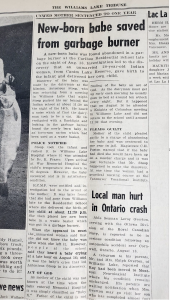
Williams Lake Tribune, Aug. 26, 1959
But somehow the super sleuths, Belleau and Spearing, didn’t think to interview either Ed or his mother.
Nor did these sleuths report the fact that Ed’s mother was 20 years old at the time of her baby’s birth and was not a student at the school. More people should know that it was mandatory for students to leave an Indian Residential School at age 16. It is most likely Antoinette gave birth to Ed at St. Joseph’s because she simply went into labor while driving home to Canim Lake Reserve from Williams Lake, a trip of about an hour and a half. Having been a student there for years, she likely pulled into St. Joseph’s in distress, hoping to find help. But it was summer and most of the students and staff were were absent.
The film also tries to make the case that former Williams Lake First Nation Chief Rick Gilbert was fathered by a priest. But his mother was not a student at St. Joseph’s either.
It is certainly curious that none of the investigative team, not Chief Willie Sellars, not the film’s star-studded producers, editors and financiers ever asked a fundamental question.
What does it take to incinerate a body?
A bit of research reveals that it takes much more than a school garbage burner. Various online sources indicate that cremation of a body takes between 2 to 5 hours at temperatures of 1,400 to 1,800 degrees Fahrenheit (about 760 to 1,000 degrees Celsius). The bones remain as brittle shards. Typically, a crematorium then crushes the bones so as to return an urn of ashes to the family, without disturbing, identifiable bony parts.
St. Joseph’s school garbage burner from the 1950s could never have attained such temperatures.
The makers of this “true crime documentary” say they worked on “Sugarcane” for three years. A few hours of historical research and a critical analysis of historical documents led me to write and publish “The Bitter Roots of ‘Sugarcane’” which exposes such flaws as these. (Bitter Roots of ‘Sugarcane’ on Rumble).
Despite these gaping holes in the story, “Sugarcane” speeds its way to an Oscar nomination. Most recently, a private screening of the film was held at the White House, with all of the film glitterati from behind the scenes in attendance.
Producer and co-director Emily Kassie was there with her father, David Kassie, a Toronto philanthropist and financier, formerly on the board of directors for the Toronto International Film Festival Group.
Julian Brave NoiseCat and Chief Willie Sellars of the Williams Lake First Nation did an impromptu drumming and singing session to add some Indigenous flavour to that colonial White House and the colonialist Academy Award potential.
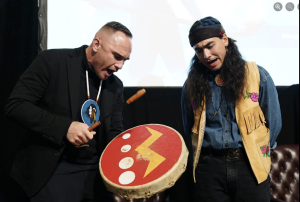
National Geographic’s Facebook page
How did this flawed film — one of the most awarded documentary films of the year, according to National Geographic’s Facebook page — get so far up the ladder?
The film’s star-studded cast of producers, editors, financiers, parents and siblings are certainly in a position to pull a few strings, make connections, and add substance to what otherwise might be a kind of down-home family therapy and tragedy film with a touch of history thrown in.
But do any of them care about facts? Or was the goal to make a gut-wrenching story that could further a social justice ‘land back’ agenda in an award-winning way, and truth be damned?
Let’s take a close look at the film’s star-studded cast.
Emily Kassie’s sister Caroline is a partner with Chelsea Clinton in their venture capital company Metadora Ventures, and she is married to Ricky van Veen who, as reported by Page Six in 2021, made a fortune “after co-founding comedy brand CollegeHumor and the video platform Vimeo. He is now the head of global creative strategy at Facebook.”
Co-director Julian Brave NoiseCat is the son of Alexandra Roddy, a high-powered marketing exec with IBM. Roddy is the daughter of Suzanne Eger and Joseph Roddy, a well-respected contributor to LOOK, LIFE, The New Yorker and New York Times.
Impact Partners were involved in the financing of “Sugarcane.” Dan Cogan is a co-founder and an Academy Award®-winning producer of Icarus., a film known for exposing the doping, corruption, and fraud in Olympic sports, particularly on the part of Russia. But Cogan’s company is a financier/adviser to “Sugarcane”, a film which appears to be a fraud, and a close look reveals the Williams Lake First Nation investigators and the filmmakers to be negligent and — some would say — corrupt in their lack of due diligence, lack of fact-checking, and their distortion of facts. It exposes their willing participation in this shock-u-mentary that obscures key facts, twists the truth and blood libels the Roman Catholic Church, in particular the priests and nuns who, in good faith, dedicated their lives to uplifting disadvantaged Indigenous communities with education and care.
It’s hard to know on whose advice and on whose tab the award-winning talent was brought on board. Talent that included Kellen Quinn, Producer, Christopher LaMarca, cinematographer, Maya Daisy Hawke, editing supervisor, and Nathan Punwar, editor,

Did those very talented individuals not have any questions like the ones posed above?
Are they all really willing to lay their reputations on the line by supporting a tale of systematic infanticide and incineration based on the ‘eye witness’ recollections of three people? Larry Emile, a self-admitted alcoholic; an unidentified woman who told the RCMP years ago that she witnessed infanticide when she was a ‘very small’ child; and Wesley Jackson, an apparently non-Indigenous individual who worked at the school and whose duties included digging holes to bury the ashes from the garbage burner, ashes in which he says he saw fragments of bones.
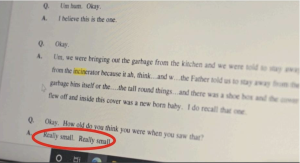
Screenshot from police files in “Sugarcane.” Red circle added.
Wesley Jackson told investigators Belleau and Spearing that he’d been paid to dig deep holes and bury the ashes from the school’s furnace, claiming that he’d seen scraps of bones. This ‘eye witness’ statement is compelling in the context of the film’s storyline, but it is meaningless as evidence without factual proof of the origin of the bones.
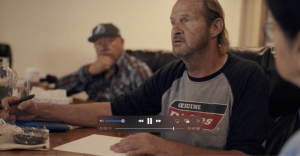
Wesley Jackson. Screenshot from “Sugarcane.”
And did he mean the furnace inside the school? Or the garbage burner in the yard?
Of course there would be bones in the school’s garbage burner. St. Joseph’s Indian Residential School was feeding approximately 300 students three meals a day; kitchen garbage was burned to prevent attracting wildlife like coyotes and bears. As noted above, the garbage burner could never reach temperatures necessary for turning human bones to ashes. Neither could the school’s furnace. For historians, unbiased sleuths and investigators, assessing these facts is key when judging the truth of the alleged crime.
To summarize: Roman Catholic priests and nuns are being vilified as infanticidal murderers, based on kitchen scraps, the delusional claims or psychotic hallucinations of a self-admitted alcoholic, and the questionable memories of a ‘really small’ child!
And what about the story of Baby Ed, whose mother put him in the garbage burner, the rescued baby who was never interviewed by Belleau and Spearing? Did no one associated with the making of “Sugarcane” read the Williams Lake Tribune article of Aug. 26, 1959? It’s certainly right there in the film.
“New-born Babe Saved from Garbage Burner. Unwed Mother Sentenced to One Year.”
But here is what viewers of “Sugarcane” will also see.
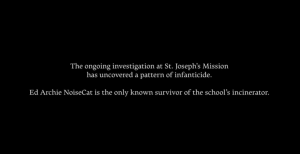
Screenshot from “Sugarcane”
This is a claim that Ed is the only known survivor of the school’s “incinerator”. In fact, he is the only known baby to have been put there, and by his own mother. Thus no “pattern of infanticide” has been uncovered, and the film is a blood libel on Roman Catholics and Canadian history.
And there is a wider issue. In “Sugarcane,” the Williams Lake First Nation investigation claimed “93 is our number” – as if this is the number of missing children. But no list of names of those children has ever been presented. In September of 2023, the claim was their number was 159. And most recently, the claim is their number is 55 – again, no names.
It’s a no-name claim of genocide being spread throughout the world by an un-fact-checked shock-u-mentary, with the help of National Geographic — a claim that rides partly on the reputations of all those noted above who are said to be extraordinary filmmakers. But none of them are good historians.
St. Joseph’s was a mission site before it was a school, and as historian Robert Carney has noted, the missions and schools were the local social services and medical hubs in the earliest times. There certainly may be unmarked graves of unknown people who came to the school for help or last rites. But graves are not evidence of nefarious deeds. And neither are garbage burners. Nor is one person’s eye-witness testimony. As criminal defense lawyer Nicholas Wansbutter stated in an interview with me, the first-person statements in “Sugarcane” are not evidence, even if they are emotionally compelling. There was no cross-examination. The statements were made in a room full of others, a situation which, as shown in the Asch Conformity experiment, tends to skew people’s statements
Historic Sexual Assault claims and memories from childhood are deemed to be especially unreliable by psychologists and lawyers.
And what is happening at the crime scene? In most parts of the Western world, it is unheard of for victims of an alleged crime to become the sole owners and authorities over the scene of that un-investigated crime, but that is apparently not how things work in Canada today.
In 2021, the Kamloops First Nation made the original ‘gut-pulling’ claim of finding 215 human remains of missing children in unmarked graves in their orchard.
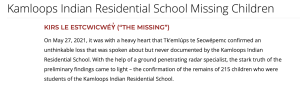
The RCMP turned the investigation over to those making the claim. Kamloops First Nation insists that the orchard is ‘sacred ground’ and they are the sole authority of this alleged crime scene. They gained control of the investigation. And the world receives no answers.
The Williams Lake First Nation had a similar win. They claim that at St. Joseph’s there was systemic rape, infanticide and incineration!. and although the RCMP play a prominent part of “Sugarcane”, where is the investigation into these heinous crimes? Will there ever be one?
Perhaps not. As reported on Sept. 5, 2023, Williams Lake First Nation became owners of St. Joseph’s Indian Residential School and lands, thanks to BC ‘colonial’ taxpayers – “The First Nation and B.C. government bought the 13.7-acre property for $1.2 million from its private owners, with $849,000 coming from the province.”

Canada’s reputation and in particular that of the Roman Catholic Church has been smeared worldwide by this blood libel fiction that masquerades as a true crime documentary. What does it say of the Oscars and of the film’s pedigree talent pool that they have willingly participated in this historical fraud?