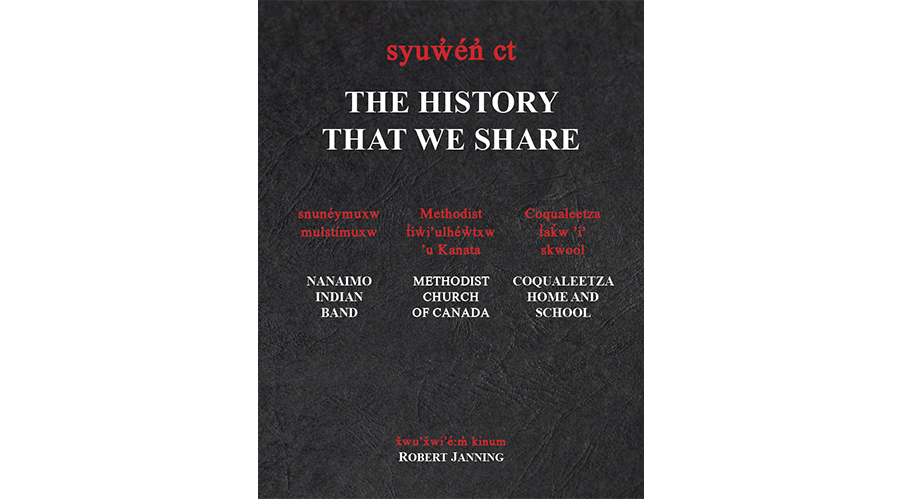
This book presents many original historical documents from 1859 to 1890 that Robert Janning has selected and reprinted. Not surprisingly, these records show the relatively positive relationships that existed between Indigenous and non-Indigenous people in Nanaimo, B.C. Janning focuses on the Methodists mission because most Indigenous people were, at the time, confirmed Methodists.
Jannings presents information on 12 Methodist missionaries beginning with Rev. Arthur Browning (1859 – 1860) and ending with Rev. Joseph Hall (1887 – 1890). Over this period, two Indigenous assistants, Amos Cushan and David Sallosalton, helped with the mission work.

Robert Janning
Some readers will be surprised to discover five key facts that they probably did not know.
First, many of the early missionaries and schoolteachers learned Indigenous languages. For example, Rev. Arthur Browning spoke Chinook and Hul’q’umi’num, and Thomas Crosby, an early teacher, spoke Chinook, Hul’q’umi’num, Nisga’a, and Sm’algyax. For people to learn these languages required considerable dedication and perseverance because there were no standardized orthographies or dictionaries for these languages.
The second vital point is that these missionaries developed admiration and respect for the Indigenous people. There were, of course, misunderstandings, but they were quickly overcome.
The third point that may surprise readers is that both the parents and the chiefs welcomed the opportunities a school would provide for their children. The documents show that most leaders and parents knew that their world was quickly changing, and their children would have to adjust to the new economic and social reality. The parents obviously thought their children would need a mission education to make the transition.
Because the people were not familiar with the requirements of school, the children were often truant. Rev. Ebenezer Robson, for example, writes about the difficulties he had ensuring that the Indigenous students attended the school. Students often missed school on frosty winter days and when their parents needed them at home.
Even though missionaries and teachers, at first, found this behaviour beguiling, they persisted and eventually the Indigenous children began attending school more regularly. In fact, the records show that the Indigenous students quickly learned to speak, read, and write in English, and then they used English to master the other school subjects.
The last chapter contains documents about the building and management of the Coquealeetza Indian Residential School. Readers will, no doubt, be interested in knowing that “Coquealeetza” is an Indigenous word meaning “place of cleaning,” because the school was situated where people came to clean their clothing in the Springtime. Readers may be even more surprised to learn that about 40% of the Indian residential schools had Indigenous names. In fact, more schools had Indigenous names than had the names of Saints.
A letter from Miss Laura Elderkin was reprinted in the concluding chapter, showing why the school was needed:
When I came here for the 23rd March, I found five girls and two boys under the care of Rev. and Mrs. Tate. Immediately after the annual camp-meeting we had three more added to the number, and a day or two later, on the 10th June, three other arrivals compelled us to move into the new building, although it was not quite ready for our occupying. We spread the beds upon the floors, and made the best of the noise of carpenters’ hammers and saws, knowing these were necessary for our comfort and convenience. Two little girls, whose mother died during the time the camp-meetings were in session, came to us now. About the first of July Miss Lawrence brought two more children from Nanaimo, and a little girl, whose mother is ill (the doctor says with consumption), came to us. Also a lad named Alfred Stephen, whose mother is dead, was sent here by his father, making our present number eighteen. The names and ages of all the children who have been under Mr. and Mrs. Tate’s care since they opened this school, I will forward, and the date of their entering. We have with us at present twelve girls and six boys. (p. 273)
The decisive point that Miss Elderkin’s letter illustrates is that missionaries often took care of orphans in residential schools, including children who were not of school age.
Janning’s book will be of interest to Canadians who know little about the relationship between Indigenous people and missionaries during the late 1800s. This book has had limited distribution, and Robert Janning has been giving copies away. If you would like a book, e-mail Robert Janning (soccerbook@hotmail.com) and he will send you an electronic copy.