Part-endians Ruining Canada with Phantom Genocide Guilt
By Michelle Stirling
Originally published on michellestirlingg.substack.com, September 2024
Note: I believe this discussion to be in the public interest. The parties named herein may or may not have benefitted from their particular status, other than what is on the public record or found in historical documents. The article deals with generalities on this issue except where specific information and links support the statements.
Almost every Canadian is aware of various ‘pretendians’ who have been ‘outed’ by activist Indigenous and Metis people who are defending their blood purity and access to Indigenous specialty grants and diversity hires. The most famous instance is probably Buffy Ste. Marie. CBC went out of their way to destroy Buffy’s Indigenous status in their Fifth Estate investigation. Likewise, Mary Ellen Turpel-Lafond, long recognized as an Indigenous lawyer, judge and children’s advocate, was outed by CBC as a ‘pretendian.’
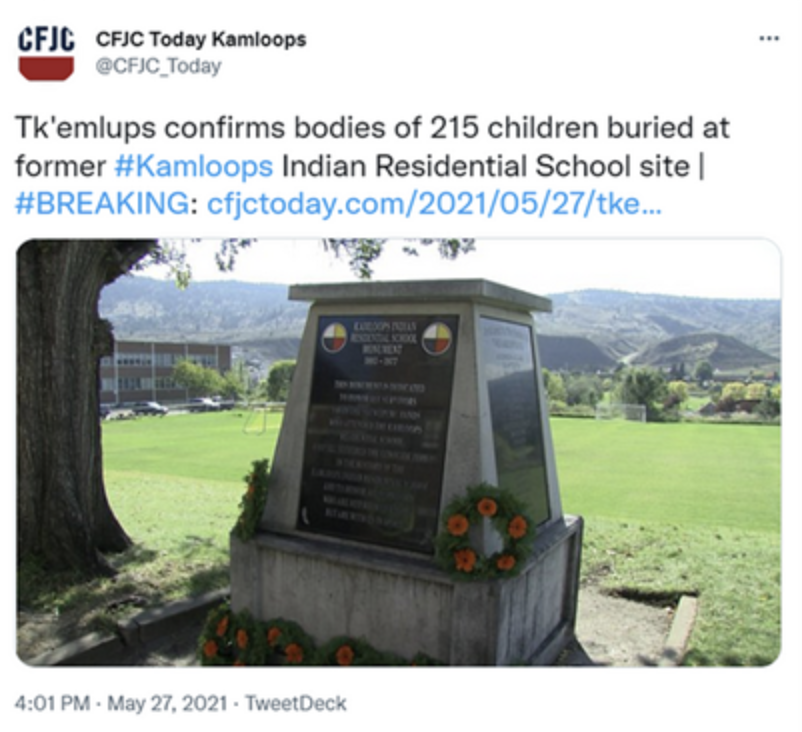
But CBC won’t publish a word that questions the phantom genocide claims that began in Kamloops on May 27, 2021.
It is clear now from Tanya Talaga’s book The Knowing that many journos and government ministers were given the heads-up on the claimed ‘find’ of 215 bodies of children in a mass grave in the orchard near the old Kamloops Indian Residential School — but no one asked for actual evidence. Talaga recounts that select journalists were given the story two days before James Peters of CFJC Today put out his tweet at 4:01 p.m. on 27 May 2021.
Who were they, these children?
Previous land use records show the area near the former Kamloops Indian Residential School, now claimed as a mass grave, is where a large old septic field lies, littered with buried, abandoned clay tiles. Imagine that thousands of Canadian school children are wearing their orange hair shirts of guilt, some of them every Friday (!) to expiate the sins of an alleged “genocide” committed by their often White ancestors in Canada, effectively feeling guilty for a phantom genocide, that is really all about an old septic field.
No major media have asked for a copy of the report from Ground Penetrating Radar operator, Sarah Beaulieu.
And from Talaga’s comments in her book, it seems like Talaga is the one who called Murray Sinclair who subsequently somehow called off an RCMP investigation of the claim of mass murdered children, in undocumented graves, allegedly murdered by priests and nuns and buried in clandestine circumstances in the middle of the night.
These claims are based on the ‘knowing’ of unnamed “Knowledge Keepers” who were five- and seven-year-old children at the time. Many Indian Residential School children were recently orphaned. With nowhere else to go, the Indian Residential School became their home. Thus, the traumatic imagery of death and graves may be fixed in their minds. But eye-witness testimony is not reliable and people’s recollections can be led.
As I have written elsewhere:
As American psychologist, David Raskin, testified in the Martensville, Saskatchewan Satanic Panic trials of the 1990s, with some prompting and leading questions from a person with confirmation bias about an event, people are able to remember all kinds of things that never happened.
A further irony is that ‘pretendian’ Mary Ellen Turpel-Lafond was one voice that called for an immediate criminal investigation. However, thanks to what appears to be obstruction of justice, the RCMP have turned the alleged murder scene over to the Kamloops First Nation. This is unheard of in criminal cases.
CBC’s Fifth Estate has no questions about that?
But I digress.
Has anyone considered the situation of the bi-racial “part-endians” or the “spouse-endians” who make up the majority of the high-profile activists accusing Canada of genocide — in fact, accusing their White relatives of intentionally murdering their own people.
This may be a strange case of a Canadian version of Stockholm Syndrome.
The Encyclopedia Britannica defines Stockholm syndrome as a “psychological response wherein a captive begins to identify closely with his or her captors, as well as with their agenda and demands.”
It is hard to know if this stems from a sense of guilt or a white man’s supposedly inherent colonial desire to cash in on opportunity.
https://www.leahgazan.ca/
Consider for instance, Leah Gazan, NDP MP for Winnipeg Centre. She is the child of a Polish Jewish father and an Indigenous mother. Her mother appears to have been a love-child of an out-of-wedlock forbidden Chinese-Native relationship back in the day. Her grandmother’s father was a devout Catholic, a descendant of the former Lakota American refugees who found refuge in Canada, in Saskatchewan, after the slaughter of Custer and the 7th Cavalry.
John Lecaine became a successful farmer, rancher and writer of great Western stories, gleaned from the elders, early pioneers and Mounties. He did go to Indian Residential School for a time, though he was not legally permitted to, being a refugee and also being Metis himself and not a Status Indian. What learning he acquired rocketed him forward to success in the community. Lecaine homesteaded, helped build the local Catholic Church and his stories were published internationally. He relied on himself, having no treaty status or government supports. And he did well. Lecaine was the product of a relationship between a pubescent native girl and a Mountie; her father urged her to take up with the Mountie as his wife and the Mountie in turn protected and fed her family.
Likely it was Lecaine’s staunch Catholic perspective on intimate relations that had the most bearing on the fact that he severed relationships with Leah Gazan’s grandmother. As Leah Gazan told parliament, Leah’s mother and brother were abandoned by Leah’s grandmother in a hotel room with a jar of peanut butter and one of jam, and a loaf of bread. They were told to ration it out as Leah’s grandmother had to go away, out to work for a week; the type of work is unknown.
Child services took the girl and boy away. Leah’s mother grew up in foster care and ultimately became a social worker, saved from precarious economic circumstances by the White system which advocates claim caused the (phantom) genocide.
Leah Gazan recounted the story in the House of Commons on 18 September 2023 (excerpt):
I want to share a story about my mother. My mother, Marjorie Gazan, was a street kid and a child welfare survivor who ended up in the system after my grandmother abandoned her and her younger brother in a hotel room in Moose Jaw, Saskatchewan, when she was five years old.
My grandmother had to leave them to earn money. There were no supports for indigenous women in the 1930s. There were no human rights. There was no one to turn to, especially for indigenous single mothers, and my grandmother was not an exception.
Since my mother was the eldest child, my grandmother left her in charge of her younger brother with specific instructions. She said, “Here is a loaf of bread, peanut butter and jam. It needs to last five days.” I remember my mother telling me how she, along with my uncle, gleefully ate the loaf of bread and ran out of their food ration in only one day. Hungry, scared and alone, my mother decided to call the Children’s Aid Society.
It is beyond most people’s imagination, especially those who have been privileged with human rights, what a five-year-old girl would have to have endured to understand who to call and how to work with the bureaucratic child welfare system to relieve her and her brother’s hunger. It was not that my grandmother did not love her, but she had grown up as a street kid, who later in life became a serious alcoholic to deal with the violent genocide she had experienced throughout her life.
Subsequently, Leah’s father, Albert Gazan, and his mother, were Jewish Holocaust survivors of an actual genocide, who were taken in by Canada and given a new life.
But Gazan regularly claims that Canada committed genocide against Indigenous people. Leah Gazan was responsible for the House of Commons passing a motion that described Indian Residential Schools as genocide on Oct. 27, 2022.
She is claiming that the country that saved her great-grandfather’s family from the vengeance of the US Cavalry, that the country’s gift of the short-lived Indian Residential School instruction for John Lecaine, which enabled him to become a capable business person, writer, and community tent-peg, is actually evidence that Canada is a cold-blooded murderer.
This is a condition that I have named “part-endian” — where there are people with bi-racial White and Indigenous roots — just like Canada’s red and white flag — but they turn on their White heritage, even though it is typically the thing that opened doors for them in terms of social skills, education, and that gave them roots and historical context. Meantime, they have exploited their Indigenous heritage to rocket themselves to the forefront of various presently popular Indigenous, environmental or climate justice movements.
In addition to Leah Gazan, other notable “part-endians” with a White parent who are in a position of prominence in Indigenous affairs include:
Mary Simon
Wab Kinew
Niigaan Sinclair
Kimberly Murray
Julian Brave NoiseCat
Jodie Wilson-Raybould
former Chief Bev Sellars
Chief Willie Sellars
Tanya Talaga
Raymond Frogner
Evelyn Korkmaz
Dr Joyce Schneider
Phyllis Webstad
Kisha Supernant
Tony Goulet
Jessie Wente
Likewise, influential Indigenous persons with White spouses include:
Phil Fontaine
Murray Sinclair
Stephen Kakfwi
Edmund Metatawabin
Romeo Saganash ( partner to Leah Gazan)
Ron Ignace
Rosanne Casimir
Virtually all of these people have publicly stated or supported claims that their White ancestors or those of their partners, committed genocide, even though they themselves (or children) would not exist without their White ancestor or spouse — and neither would many of their Indigenous family members.
I suppose it is fashionable to jump on the genocide bandwagon since everyone’s doing it, and there’s about $79 billion dollars at stake in various land claims, ad hoc or de facto reparations, money for grave digging, maybe for movie making. If you can prove to the world, by denigrating the White half (or less) of your own DNA (or spouse) and cultural heritage, just how Indigenous you really are, the money is yours for the taking.
It is ironic how much venom is projected toward outed “pretendians” who fail to pass the bi-racial “Indian-enough” test — people like Mary-Ellen Turpel Lafond (who certainly misrepresented her ethnic heritage); so perhaps that is why many of these “part-endians” are willing to turn on the White half of their heritage with public venom so that no one asks the questions I am asking here.
Western Civilization, Roman Catholicism and Christianity came to Canada via the fur trade and early Indigenous tribes could have easily wiped out the stupid White people who came here, totally unprepared for what they thought was the “New Andalusia” ….Canada turned out to be a hell hole of cold in winter and the newcomers became a banquet for black flies in summer.
But somehow, Indigenous people were attracted to these strange White folks and their “cargo culture” brought on huge ships from places they knew not. Somehow they were fascinated by the horses, the guns, the metal knives and tools, the cooking pots, the metal traps, the flint, the canned biscuits, the flour, sugar and tea, and…those colorful beads and ribbons.
Lard and flour bought from Hudson Bay Company traders became Bannock. Parks Canada lists it as having originated with Indigenous people.
‘Bannock’ is an old Celtic word meaning ‘a piece of a loaf or cake’. (Crystal, David, The Story of English in 100 Words, p. 37)
Historical examples dating from Old English can be found in the online Oxford English Dictionary (available by subscription). Here is just one example:
bannock
The name, in Scotland and north of England, of a form in which home-made bread is made; usually unleavened, of large size, round or oval form, and flattish, without being as thin as ‘scon’ or oat-cake. In Scotland, bannocks are usually of barley- or pease-meal, but may be of wheaten flour
The word ‘bannock’ is thus not an Indigenous word, and the food itself is not an Indigenous food. Bannock was introduced to Indigenous and non-Indigenous alike in Canada in the early days of the fur trade in the early 1600s. In fact, bannock is an example of Indigenous cultural appropriation from Europeans.
Another cultural appropriation is the way otherwise useless things like the lids of tobacco tins were rolled into little cones to decorate dresses. And so the jingle dances were born — a blend of West and East.
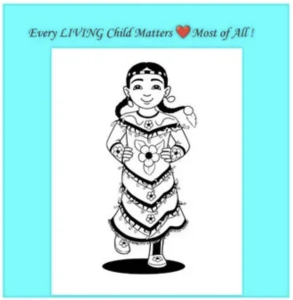
Image licensed from Shutterstock
Should we not instead celebrate how we all came together and created a great nation?
And what of Christianity? The earliest Catholic conversions, by choice, dating back to the 1610 Indian Residential Schools, were not the Spanish Inquisition of Canada — though that is how they are framed. Parents voluntarily enrolled their children in schools that supported their chosen Christian denomination, just as today a Catholic parent enrols their child in a Catholic school.
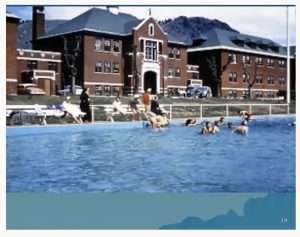
Kamloops Indian Residential School featured an Olympic-sized swimming pool.
On the prairies, in the mountains, in the north, somehow the strange liturgy of the Oblate Fathers, loner men bravely roaming the wilderness, not in a tribe, all dressed in flowing black robes, a huge cross hung around their neck; and the devotion of the small groups of women dressed in grey who nurtured the weak and sick and who welcomed the burden of care for Indigenous orphans — somehow their way of life, hymns, and prayers appealed to the vast majority of Indigenous people in Canada.
Those Indians adopted Christianity in droves, and, to this day, many Indigenous people and Metis are very devout Roman Catholics or Christians of other denominations. In crossing such cultural paths, the people also intermarried. The red and white intertwined. Countless Canadians are some part Indigenous, as was Father Lacombe; countless Indigenous Canadians (not just Metis) are partly White.
Yet, the “part-endians” try to claim that this voluntary adoption of Christianity and the subsequent opportunity to learn to read, write, do math and acquire skills at Indian Residential School was a cruel debasement of their former Garden of Eden; that their Indigenous half was the Noble half; that their White half was wicked.
It’s a toxic, psychopathic combination of Blood and Soil Romanticism and racist self-hatred, vaguely reminiscent of pre-war Nazi Germany’s “Blut und Boden” obsession with mystical tales of super powers, derived from a special relationship to the blood and soil of Germany. Ironically, that movement relied on racial purity, something these “part-endians” lack. But it has brought us into a world of race-based law, aboriginal exceptionalism, and demands for “land back.” Who wants that land back? The colonial White half, or the Indigenous half that engaged in trade over centuries, claimed their peoples had no concept of land ownership and property rights, and who willingly signed treaties long ago?
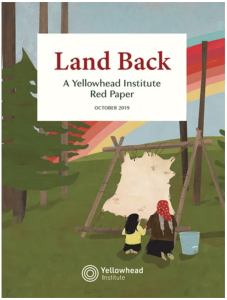
https://redpaper.yellowheadinstitute.org/wp-content/uploads/2019/10/red-paper-report-final.pdf
Except the “part-endians” are not mostly aboriginal by blood.
Yet they are the loudest promoters of the phantom genocide of Canada. The genocide of missing children whose names are unknown and for whom there are no unresolved missing persons reports over the course of 113 years and 149 Indian Residential Schools.
No questions?
For some, the part-endians’ love of their Indigenous half is too often concerned with chasing a buck or cashing in on other opportunities to dress in “full regalia,” claiming a heritage never lived by many of them.
“Part-endian” ideology is destroying Canada, a nation where so many of us are an amazing mosaic of mixed bloods and cultures and where, until about the wrapping up of the so-called “Truth and Reconciliation Commission” in 2015, we all lived fairly peacefully together.
And yes, there was then, and is now, great economic disparity in Canada, something that the billions of compensation dollars paid to Indigenous individuals and Bands, and other paid out claims curiously have not remedied. If anything, things have gotten worse for many Indigenous people living on reserve since the Truth and Reconciliation Commission.
Few “part-endians” have ever endured what Indigenous people on reserve typically endure — living in a house with 10–15 people and one bathroom. Few of them really care about that either, even though they are probably in a position to help fix it. These are the people who fly to climate and environmental justice conferences and get foreign funding or deals for books. People who take seats at international councils just for presenting themselves as being Indigenous in some way, often in the right costume or headdress, with a sprinkling of native words to bamboozle the audience even more.
They keep themselves busy rewriting Canadian history and ruining Canada with false genocide guilt while cashing in on our national propensity to say, “I’m sorry.”
Let’s end “part-endian” preferential treatment and their divisive, untrue tropes.
Let’s all just be Canadians once again.