This article was originally posted on the Sorry No More Substack on August 19, 2026. It is reposted with permission by the author.
How Niigaan Sinclair and Sean Carleton Distort the Public Narrative on Unmarked Graves and Indian Residential Schools
Canadian Dimension just published an article by University of Manitoba academics, Niigaan Sinclair and Sean Carleton. They denounce the Globe and Mail’s recent mea culpa over its own shoddy reporting of five years ago on the matter of the claim by the Kamloops Indian Band that 215 children’s bodies had been found in the old apple orchard by the former Kamloops Indian Residential School. They say that they’d submitted their article to the Globe and Mail but it had been declined.

The ‘215’ news was so shocking, almost everyone fell for it, including the so-called “paper of record”, the Globe and Mail, and the US paper of record The New York Times.

https://www.nytimes.com/2021/05/28/world/canada/kamloops-mass-grave-residential-schools.html
Sean Carleton himself fell for it.

Sinclair and Carleton carry heavy burdens of defence.
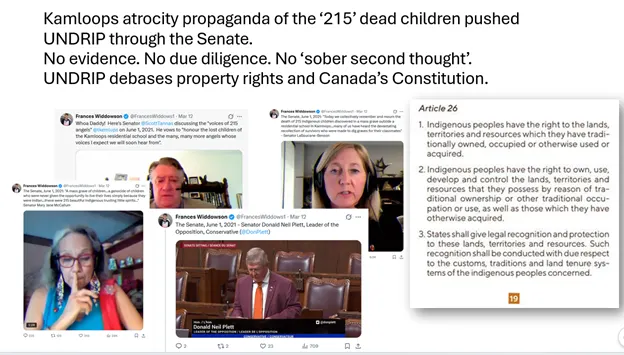
Carleton must defend his paper that shreds former Senator Lynn Beyak, which, by sheer coincidence, was published on June 06, 2021, by Taylor & Francis online. Its title, ‘I don’t need any more education’: Senator Lynn Beyak, residential school denialism, and attacks on truth and reconciliation in Canada.” This incendiary title undoubtedly outraged many people who were grieving the loss of the unnamed little angels, as even Senator Scott Tannas and other Senators were in tears. Senator Tannas promised to go home that night and read all the 94 calls to action, wherein implementing UNDRIP is demanded or mentioned some ~28 times.
Carleton, who likes to claim that people like me who add historical context to the conversation are just in it for the money, clicks or recognition, surely benefitted from that fortuitous timing of the Taylor & Francis publication! Look at the metrics for his paper!


For academics, metrics like this are like having someone hand you gold bars to stuff in your back-pack.
Now, I am sure it is an absolute coincidence that Carleton’s paper was published just nine days after the Kamloops announcement of finding 215 bodies of children, or alternately described as finding the human remains of 215 children in a mass grave, unmarked grave or graves.
And what a coincidence that the House of Commons had passed Bill C-15, the United Nations Declaration on the Rights of Indigenous Peoples (UNDRIP), on May 25, 2021, just two days before the announcement. According to Tanya Talaga’s account, in her book, “The Knowing”, they already knew about the find and she and other select media and friends had been engaged in ceremony on site for three days!
Now, you would think that such a finding should have been communicated immediately to the RCMP, Prime Minister and House of Commons, but no, they waited a couple of days, I guess.
Was it to be sure that UNDRIP passed through the House of Commons okay? Was it to evaluate the numbers for and against, to try and figure out if the Senate would likely pass it, or if the Conservative Senators would filibuster it again?
BUT, it still had to pass through the Senate. Advocates for UNDRIP (i.e. all the people associated with the Indian Residential School Settlement Agreement (IRSSA), the Truth and Reconciliation Commission (TRC), the TRC’s 94 Calls for Action (in which UNDRIP is mentioned some 28 times) and the National Centre for Truth and Reconciliation (NCTR and its master, the University of Manitoba) and the Assembly of First Nations, certainly wanted to see Bill C-15 pass, and not get stymied by the Senate like that last time in 2018.

So, undoubtedly the perfect timing of publication of Sean Carleton’s paper would have made all of the Conservatives and Conservative Senators very worried, bringing back the bad memories of how former Senator Lynn Beyak was struggle session-ed and then subjected to cancel culture and almost kicked out of the Senate for insisting the Indian Residential Schools had merit. She resigned in January of 2021, as Sean Carleton writes about in this National Observer article. No sitting senator wanted that to happened to them – especially not in a now-fraught environment of claims of an actual mass grave, which always elicits images of the Holocaust or Holodomor…a mass grave of 215 unnamed CHILDREN, as young as three, we were told by the unquestioning media, buried by their classmates aged six, who had to dig graves in the middle of the night, directed by priests and nuns.
Honestly, if you tried to sell this as a movie script in Hollywood, they would laugh you out the door.
But since the Globe and Mail and the New York Times – both papers of record – uncritically published the stories, almost verbatim from press releases, along with a flood of stories from CBC, the national broadcaster, and as they did interviews with alleged victims/descendants (who had never previously mentioned missing children) or quoting the words of anonymous living witnesses in the Kamloops Band – well, it became gospel truth.
I like to ask people to consider this.
If you knew, on May 26, 2021, that in May of 2015, the Kamloops Indian Band had filed a civil suit for aboriginal title over all of the City of Kamloops, the Sun Peaks Resort, and many lakes and surrounding territory, but over the course of six years, there had been no resolution of their land back claim, would you have believed the atrocity propaganda of May 27, 2021?
Because the magic of having UNDRIP pass is…LAND BACK!

So, aside from his other academic endeavors as a settler historian, Sean Carleton has the above scenario to defend. It should be noted that his published article in Taylor & Francis is what is known as ‘open access’ – meaning that a significant upfront fee is paid to the publisher so that anyone can download the paper for free. Normally, peer-reviewed journals charge a fee for published papers; that limits distribution, of course, to academics with institutional accounts.
As for Niigaan Sinclair, he carries the burden of his father’s legacy.
Murray Sinclair was a pivotal character to much of Indigenous activism in Canada and he was a commissioner of the Truth and Reconciliation Commission. Though early on in the process, Sinclair, Sr., called for the telling of all sides of the stories emanating from Indian Residential School experiences, that seems to have been quickly lost along the way.
This is the kiosk that welcomed people to the public witnessing sessions. Almost every statement is false or wildly exaggerated. It certainly set the tone and expectation for what people were to say. As Ronald Niezen wrote in “Truth and Indignation”, people who stood up to speak about their good experience at the schools were shouted down. Mayhem.
Important point. The statements at the hearings were recollections, not sworn testimony with documented evidence.

Murray Sinclair began pulling extraordinary numbers of alleged Indian Residential School deaths out of his hat – numbers like 10,000 to 25,000 – maybe even more.
Such numbers don’t add up.
As I have written elsewhere this is a phantom, no-name genocide:
In Canada, such a thing [as the Argentinian ‘desaparecidos’] cannot even be replicated because the death certificates are all filed with the provinces with rare exception. It is known what people died of, where, and where they were buried. That a wooden cross or headboard has disintegrated over time does not indicate any nefarious deed.
Some Indigenous people have claimed that in each family 4 or 5 family members went missing at Indian Residential Schools. This is not possible based on simple math.
Of the 150,000 Indian Residential School students (as estimated by the government), 103,203 of them were still alive in 2007.
This means 69% of the students who attended an IRS institution over a period 113 years, were still alive 124 years after the first government-funded schools were established.
The claim of ‘genocide’ is false.
Some might ask what happened to the 46,797 other students of the 150,000 noted above. Are they not the ‘missing?’ No. They are accounted for in provincial death records and church/school registers where available. Life expectancy in Canada was low in the early decades. People lived shorter lives in earlier times. Tuberculosis killed one Canadian every hour of the day and two Canadians every hour of the night in 1908, according to Dr. George Wherrett’s “The Miracle of the Empty Beds.”

But now Niigaan Sinclair must maintain his father’s legacy, and that includes the tropes about large numbers of deaths and genocide.
It should be noted that both of these gentlemen are employed by the University of Manitoba which holds the Trust Deed for the National Centre for Truth and Reconciliation (NCTR). The NCTR employs about 22 people, and the University of Manitoba employs some 10,457 academics and support staff.
Every time a so-called ‘denialist’ calls into question the claims of murdered or incinerated children, any number of potential multi-million-dollar grants may go up in smoke.
So, these two fellows are fighting for their reputations, for their jobs, for a family legacy, for an archive that is supposed to embody the ‘truth’, but to keep getting the grants, it must forego the truths that I tell, and for a university that would be publicly shamed if a more balanced story on Indian Residential Schools was revealed to the public, and taxpayers realized they’d been had for millions and billions of dollars.
Lots of good things happened at Indian Residential Schools, and some bad things happened, too. Just like in life. So let’s be honest about both.