McCRAE: Reconciliation a two-way street — and takes courage in each direction
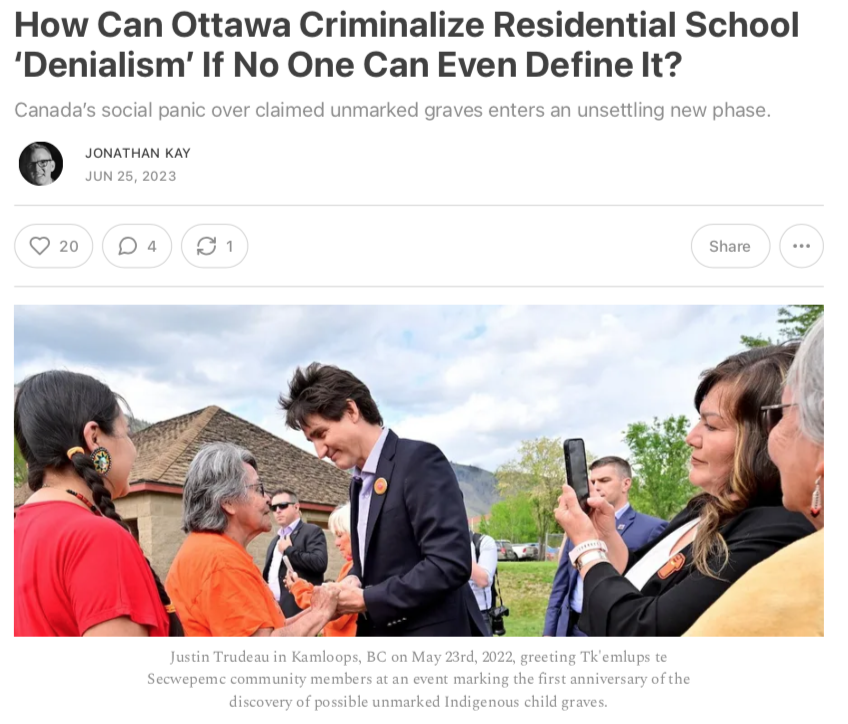
There is a lexicon currently used by Indigenous leaders, activists, politicians and others to sensationalize and condemn the history of Canada and Canada’s Indian Residential Schools (IRS.)
It is used to criminalize those of the Christian faith, particularly the Catholic church, but other denominations as well. The lexicon is clearly intended to make the negative parts of our country’s history appear much worse than they actually were. It not only focuses our attention solely on the wrongs of the past, but it also turns us against each other as we try to look to the future.
Intentional or not, the lexicon also includes words or phrases that make Indigenous people feel they are lesser Canadians and permanent victims.
The lexicon is used to make non-Indigenous Canadians feel greater levels of guilt than factual evidence would justify.
It is used to extract billions from taxpayers, to demand “land back,” proclaim Indigenous sovereignty and lay greater claim to Canada’s resources.
Governments — especially the current federal government — are afraid. They are afraid to say or do anything that might be seen as contextualizing conditions at the schools. They are afraid to be seen by the “Indigenous industry” as repudiating any part or parts of the story told by the Truth and Reconciliation Commission (TRC) or its successor, the National Centre for Truth and Reconciliation (NCTR).
They are afraid to question anything associated with the TRC or the NCTR because those institutions have been promoted to be independent, impartial, trustworthy and even sacred.
We live in a country that has endured the violence and destruction of the Oka crisis, the Wet’suwet’en blockades, the toppling of statues, and other disruptions that include the torching of dozens of churches, mostly Catholic. Governments fear more of this, so they are afraid to say “no” to any indigenous demand, no matter how unfair, unjustified or even preposterous.
The federal government routinely settles justiciable lawsuits, pursuant to former Attorney General Jody Wilson-Raybould’s Indigenous practice directive, tying the hands of federal lawyers when addressing Indigenous legal claims — no matter the merits, or otherwise, of those claims.
Canadians who care about the future of Indigenous people — and the future of Canada — should take the time to learn what is — and what is not — true about their country’s history. But that learning is impeded almost every day by the way legacy media, government spokespersons and others besiege Canadians with false allegations and stories, consistently using the Indigenous grievance lexicon.
Here’s a short list — in no particular order — of the words used most often to stir up anger, resentment, loathing, guilt, recrimination and anything else that might keep the fires of division burning brighter and brighter.
- Colonialism
- Settler colonialism
- Survivor
- Forced to attend
- Atrocities
- Graves
- Mass graves
- Unmarked graves
- Potential graves
- Possible graves
- Heartless
- Hate
- Unspeakable
- Truth
- Sacred
- Reconciliation
- Racist
- Isolation
- Starvation
- Abuse (physical, emotional, sexual, spiritual)
- Assimilation
- Cultural genocide
- Destruction of culture
- Destruction of languages
- Destruction of families
- Murder
- Holocaust
- Genocide
And finally,
- Denialist..
This last one is quickly becoming a favourite, used in an effort to silence people who simply want the truth to be the guide for the healing of our country. Now, anyone who questions any part of the grievance narrative is condemned as a “settler colonial denialist,” a “racist,” and any other useful epithet in the lexicon in an effort to silence and shame.
Name-calling has become a perverse sport: what other nasty or catchy words can be found to revile, cancel or destroy those who want truth to be told?
We don’t hear the name-callers and denouncers talk about Canada’s home-grown apartheid, the Indian Act — the Act that is the foundation of the Indian Residential Schools.
Since 1876, the Act and the treaties have been the means of ghettoizing First Nations people on isolated reserves, away from job opportunities, away from the hope of home ownership, away from the hope of living together in harmony with other Canadians.
For some reason, we don’t hear Indigenous leaders and their activist partners repeating the themes of Dr. Martin Luther King, Jr. or Nelson Mandela: integration, freedom, equality.
Equality!
King lived and died for these things.
Mandela spent 27 years in prison for his belief in equality.
But instead of learning from that, those in the Indigenous Industry have dreams that focus on enriching and aggrandizing its leaders and keeping grass-roots First Nations Canadians where they seem to want them: living on poor reserves and remaining under their control.
At the March for Integrated Schools in 1959, Martin Luther King entreated: “Make a career of humanity. Commit yourself to the noble struggle for equal rights. You will make a better person of yourself, a greater nation of your country and a finer world to live in.”
On another occasion in 1963, he said, “Darkness cannot drive out darkness, only light can do that. Hate cannot drive out hate, only love can do that.”
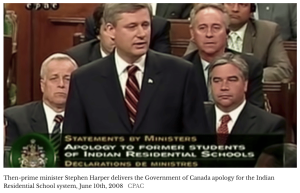
Since Prime Minister Stephen Harper’s 2008 apology for the history of Indian Residential Schools, there has been a virtual absence of light, and an almost daily dose of government and media darkness.
Apologies, remorse and compensation are supposed to result in light, understanding, forgiveness and even love. Sadly, those words do not resonate with some people. But wouldn’t it be nice if those people would finally accept that these things all travel on the same two-way street?
Unhappily, after all these years, those four words are still missing from the “official” IRS lexicon. Only courage at the highest levels of Indigenous and non-Indigenous leadership can heal this national melancholy.
Do Indigenous people — and all Canadians — care enough — or have the will — to demand that courage of their leadership?
James C. McCrae, is a former attorney general of Manitoba and Canadian citizenship judge