This article was originally published on June 3, 2026 on the Western Standard website. It is reposted with the author’s permission.
Five years after the announcement that shocked the world, unanswered questions remain about residential schools, missing children, and the media’s role in shaping public perception.
That half-truths or outright distortions dominate mainstream media reports about Canada’s Indian Residential Schools has once more been verified by the contents of two recent pieces marking the fifth anniversary of a May 27, 2021, announcement that reverberated around the world. That was the day the chief of British Columbia’s Kamloops Indian Band declared war on the foundation of Canadian truth-telling, a once cherished, universally applicable doctrine grounded in Western-rooted Enlightenment notions of scientifically verified, potentially falsifiable empirical evidence.
“It is with a heavy heart that Tk’emlúps te Secwé pemc [Kamloops Indian Band] Kukpi7 (Chief) Rosanne Casimir confirms an unthinkable loss that was spoken about but never documented by the Kamloops Indian Residential School. This past weekend, with the help of a ground-penetrating radar specialist, the stark truth of the preliminary findings came to light — the confirmation of the remains of 215 children who were students of the Kamloops Indian Residential School,” said the statement.
“We had a knowing in our community that we were able to verify. To our knowledge, these missing children are undocumented deaths,” stated Kukpi7 Rosanne Casimir.
As we have known since nearly the beginning (see here, here, here, here, here, and here), nothing could be further from the truth. Not only have the “preliminary findings” never been documented, but their veracity has also been repeatedly challenged by an abundance of contrary evidence, the most compelling of which is that no family member whose child attended the Kamloops Indian Residential School has ever reported the name of a missing student who never returned home.
Equally telling, taken at face value and supported by other evidence, this announcement says that mysterious localized indigenous ‘knowings’ consisting of unproven assertions held by unknown Aboriginal knowledge keepers take precedence over facts discovered, revealed, and transmitted using scientific methodology rooted in the principles and practice of falsifiability.
No better examples of the complicity of the mainstream media in accepting and spreading indigenous gossip, rumours, myths, and unsubstantiated allegations can be found than in the following editorials from Canada’s two leading national newspapers, the National Post and the Globe and Mail.
According to Ari David Blaff, a reporter with the National Post, “Sexual abuse was prevalent. Over 30,000 claims of sexual abuse or sexual assault have been filed by former students, with $2.8 billion in compensation paid as of April 2015.”
The residential school system was “a systematic, government-sponsored attempt to destroy Aboriginal cultures and languages and to assimilate Aboriginal peoples so that they no longer existed as distinct peoples,” the TRC [Truth and Reconciliation Commission] concluded in volume 4 of its report.
In 2015, the Truth and Reconciliation Commission said that as many as 6,000 indigenous children died in the system, which included 139 schools over the century and a half they operated in Canada. The rate of indigenous children dying in the first decades of the residential school system was high, mostly due to tuberculosis and influenza. Many children’s bodies were never returned home.
As for the Globe and Mail’s Editorial Board opinion piece, it argues that two things can be true at the same time. Five years after the startling announcement that there were hundreds of possible unmarked graves near a residential school in Kamloops, BC, there has been no public confirmation of the discovery of any human remains. That is reality, one reality.
Another is this: 3,200 indigenous children, at least, died at residential schools, according to the 2015 report of the Truth and Reconciliation Commission. Residential school students died at a rate far higher than children in the rest of Canada — a negligence so deep-rooted that it came “within unpleasant nearness” of manslaughter, according to a government official in the early 1900s.
Many students were physically abused or sexually abused. And all were the target of a systemic effort by the Canadian government, over decades, to snatch them from their homes and families, and to eradicate their culture and heritage. That, too, is reality, a damning reality.
Among the many false or deceptive assertions in these two pieces is that “3,200 Indigenous children, at least, died at residential schools, according to the 2015 report of the Truth and Reconciliation Commission.” In fact, only 423 named students died while physically present in these 139 boarding schools over their 113 years of government funding and oversight.
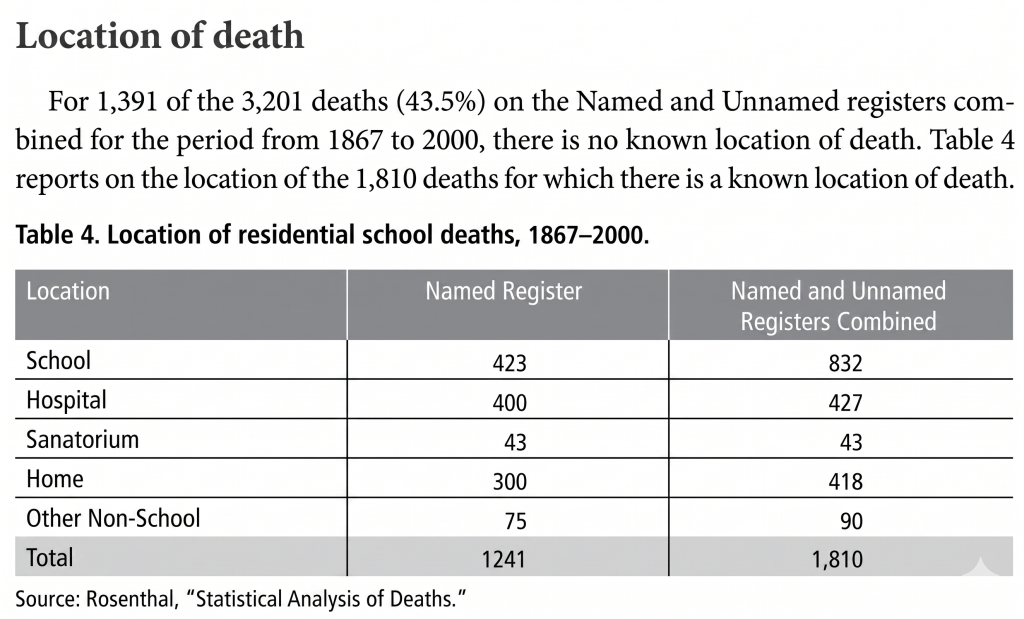
Location of Death
This is truly a sad fact, but it does not constitute genocide, which is a deliberate attempt to exterminate a particular ethnic or other collectivity. To come up with the 3,200 figure, the TRC had to stretch the truth to incorporate any child who died while registered as a school student or within a year of leaving their school.
Moreover, neither the National Post news story nor the Globe and Mail editorial mentions that, unless they were orphaned, neglected, abandoned, or abused, children were voluntarily sent to these boarding schools by their parents or guardians following their signing of a required attendance application.
Nor does either newspaper acknowledge the findings of a multi-year 2003 Native Indian Residential Schools Task Force investigation, which found that, “ … outright allegations of murder to deaths caused by negligence, and even included allegations that babies were being killed and buried on the school grounds [in British Columbia] … were thoroughly investigated by both the Task Force and the applicable Sub-Division Major Crime Unit. Not one of these allegations has ever been substantiated, much less proven, and in many cases, investigation has established that the death was due to either disease or some other natural cause: in some cases, the alleged victim was found to be alive several years after his supposed death.”
In addition, a 10-year 2010 RCMP criminal investigation of sexual abuse at Manitoba’s Fort Alexander Indian Residential School, involving 80 force officers who spoke to 700 people across North America, resulted in a single charge laid against a 92-year-old Oblate priest, Arthur Masse, who was arrested in June 2022 and charged with indecent assault. The complainant, Victoria McIntosh, alleged that he had kissed her and “fondled her above her clothing” in a bathroom at the school at some time between 1968 and 1970. Masse was acquitted, as McIntosh’s identification of him “was not sufficiently reliable.”
This is truly a sad fact, but it does not constitute genocide, which is a deliberate attempt to exterminate a particular ethnic or other collectivity. To come up with the 3,200 figure, the TRC had to stretch the truth to incorporate any child who died while registered as a school student or within a year of leaving their school.
Moreover, neither the National Post news story nor the Globe and Mail editorial mentions that, unless they were orphaned, neglected, abandoned, or abused, children were voluntarily sent to these boarding schools by their parents or guardians following their signing of a required attendance application.
Nor does either newspaper acknowledge the findings of a multi-year 2003 Native Indian Residential Schools Task Force investigation, which found that, “ … outright allegations of murder to deaths caused by negligence, and even included allegations that babies were being killed and buried on the school grounds [in British Columbia] … were thoroughly investigated by both the Task Force and the applicable Sub-Division Major Crime Unit. Not one of these allegations has ever been substantiated, much less proven, and in many cases, investigation has established that the death was due to either disease or some other natural cause: in some cases, the alleged victim was found to be alive several years after his supposed death.”
In addition, a 10-year 2010 RCMP criminal investigation of sexual abuse at Manitoba’s Fort Alexander Indian Residential School, involving 80 force officers who spoke to 700 people across North America, resulted in a single charge laid against a 92-year-old Oblate priest, Arthur Masse, who was arrested in June 2022 and charged with indecent assault. The complainant, Victoria McIntosh, alleged that he had kissed her and “fondled her above her clothing” in a bathroom at the school at some time between 1968 and 1970. Masse was acquitted, as McIntosh’s identification of him “was not sufficiently reliable.”
What both opinion pieces also ignore or are unaware of is that some truths are more veracious than others, and that so-called balanced reports — presenting the divergent positions of different parties — are not necessarily unproblematic, especially when the broader context is deliberately ignored.
Sexual abuse, for example, has always been ‘prevalent’ in boarding schools, including those attended by the offspring of wealthy parents, a factual assertion never mentioned by the mainstream media.
As for widespread sexual abuse in Canada’s Indian Residential Schools, according to gifted researcher Nina Green, this claim, “… originated in 1990 when Phil Fontaine, head of the Manitoba Assembly of Chiefs, was interviewed by the CBC’s Barbara Frum. Fontaine attended the Fort Alexander Indian Residential School in Manitoba and claimed in the interview that he had been sexually abused at the school and that every boy in his Grade 3 class suffered the same abuse. When questioned by Frum, Fontaine declined to describe the nature of the abuse. However, in a Statement of Claim filed in a class action lawsuit in 2005, Fontaine stated that he had been ‘made to disrobe and bathe in the presence of the priest.’ Since every boy in his Grade Three class had endured the same sexual abuse, it is clear that the sexual abuse Fontaine and his classmates suffered was having to take a weekly shower. The shower was supervised by school staff to ensure that the boys put their dirty clothing in bags for the laundry, showered without mishap or mayhem, and got the right clean clothing for the coming week. It was a routine procedure, and there was nothing sexually abusive about it. Had Fontaine told Barbara Frum that at the time, Canada would be a different country today.”
Also, the education of the children of non-English or French-speaking immigrants has always been intended to assimilate them into mainstream society and culture. This remains true today as it was in the past. The best proof is that as many parents as can afford to do so have often sent their children to private schools associated with their ethnic or religious background.
Equally important, the figure of 6,000 indigenous students who died in residential schools is a crude estimate, while the 3,200 figure is deceptive: most deaths occurred after children were taken to regional hospitals or after returning home following exposure to European diseases to which indigenous people had little or no natural immunity. Moreover, students often entered their boarding schools already infected with diseases, especially tuberculosis, contracted in their overcrowded and poverty-stricken reserve homes.
Finally, dead children were returned home to their families for burial whenever possible.
The term “missing children,” as defined by the TRC, is so expansive that its relation to neglect, abuse, or even murder is factually indeterminate.
The term missing children in this context includes both those who died at school and those whose fate after enrolment was unknown, at least to their parents. This could include, for example, students who might have run away to urban centres and never contacted their home community again, students who never returned to their home communities after leaving school, students who became ill at school and were transferred to a hospital or sanatorium and died there (possibly several years later) without parents being informed, or students who were transferred to other institutions such as reformatories or foster homes and never returned home.
Indeed, the TRC Report was more circumspect than either the National Post or the Globe and Mail about these issues: Some students died at the schools, while other seriously ill children were returned home, or admitted to hospitals or sanatoria, where some may have later died. Some of the deceased were returned to their families for burial, but most others were likely buried in cemeteries on school grounds, or in nearby church, reserve, or municipal cemeteries. We have no clear sense of the relative frequency with which these alternatives were employed.
Nor is there any mention in volume 4, Missing Children and Unmarked Burials, of the 2015 TRC Report of thousands of missing children buried in unknown cemeteries. In fact, none of the 94 Calls to Action developed by the TRC make any mention of searching for abused, neglected, or murdered missing children buried in unmarked graves.
In fact, there is now clear evidence about so-called missing children for many of the schools, an issue carefully documented by star researcher Nina Green. As Green’s efforts show, the TRC neglected to systematically study the thousands of publicly available death records of IRS students.
As for the National Post and the Globe and Mail, the “damning reality” of both pieces is their equal indifference to nuanced and contextualized truth-telling, compounded by the most damning reality of all: there is not a single documented case of an indigenous child being murdered by caretakers at an Indian Residential School during the 113 years of government funding and oversight.
To be sure, Canada’s Indian Residential Schools were imperfect institutions, marked by chronic underfunding and cultural antipathy of indigenous children to rote learning, especially in their early years. Discipline was often harsh, but no harsher than in other residential schools during the same era. Even so, despite these shortcomings, few countries have done more to protect the well-being and enhance the future opportunities of their indigenous children.