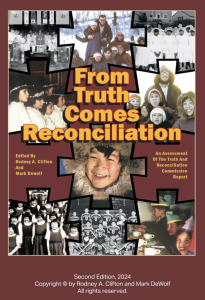
The 2nd edition of a very important book may ignite fresh debate about one of Canada’s most contentious and complex issues: the history and legacy of the nation’s Indian Residential Schools. First published in 2021, From Truth Comes Reconciliation: An Assessment of the Truth and Reconciliation Commission Report, edited by Rodney A. Clifton and Mark DeWolf, challenges Canadians to reconsider the widely-accepted residential school narrative that has gained steam with every year since the six-year multi-million dollar Commission released the report that should have provided an accurate summary of the TRC’s findings.

Should have, but did not.
Published by Sutherland House Books and backed by the Frontier Centre for Public Policy, From Truth Comes Reconciliation provides a serious assessment of the Truth and Reconciliation Commission’s (TRC) multi-volume Report, arguing that while the Report as a whole offers a great deal of valuable information about the Indian Residential School (IRS) system, its Summary and Legacy volumes offer only a greatly simplified and misleading picture of the system’s history and the residential school experience. While fully acknowledging the harm inflicted over the 113-years of the system’s existence, the editors and contributing authors provide important statistical information that didn’t make its way through to the Canadian public, and they delve into the less-discussed stories of Indigenous communities who requested a residential school, parents who wanted their children to attend one of the schools, and dedicated teachers who sought to provide Indigenous children with education and skills. The book’s central argument is that true reconciliation can only happen when Canadians confront the full, complicated, and nuanced reality of what is, for many people, a painful chapter in the nation’s history.


From J.R. Miller’s 2016 review of the TRC’s Final Report
“At a time when Canadians are critically examining their past, this book invites readers to reflect on the trauma and the complexities of the residential school system,” says editor Rodney A. Clifton. “Reconciliation requires confronting the whole truth – not just one side of the story.”
From Truth Comes Reconciliation takes a bold stance by exploring the legacy of residential schools from multiple angles. Clifton and DeWolf include accounts of educators who, despite the failures of the system, aimed to prepare Indigenous children for the challenges of 20th-century life, and other IRS staff members who did their best to provide care and support to the students in their charge. While the editors do not downplay the lasting damage caused by residential schools in some instances, they argue that understanding the broader scope of experiences is vital for genuine reconciliation.
This book does its best to honestly critique the entire TRC Report, arguing that its Summary message, so often repeated in the media, fails to fully represent the complexity of the Commission’s findings regarding residential schools. It highlights gaps and omissions in the wider Report and advocates for a more inclusive narrative that reflects the diverse realities of those who lived through the system. The book contains a number of chapters written by concerned Canadians who contribute personal experience, the results of diligent research, and well-argued commentaries on the Report and its consequences.
“This book is about fostering understanding, not division,” explains retired teacher of English Mark DeWolf. “By exploring the full picture – the harm, the help, and the hopes – we have contributed to a path that should take us closer to Murray Sinclair’s goal of reconciliation.”
Editor DeWolf brings a rare, personal perspective to the discussion. As a former but non-Indigenous student at St. Paul’s Indian Residential School on Alberta’s Blood (Kainai) Reserve, he shares his firsthand experiences of the system, adding depth and authenticity to the book’s analysis.
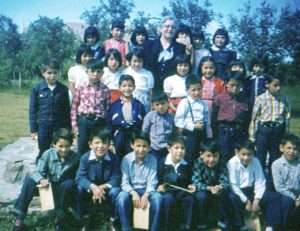
One class of students enrolled at St. Paul’s Anglican Indian Residential School in the late 1950s
The testimonies of other Canadians who lived and worked in the schools are featured in a new chapter. These testimonies, coupled with Rod Clifton’s personal experiences and extensive academic background in Indigenous education, help the book to combine personal experience with scholarly rigour.
Since the book’s initial publication in 2021, the editors’ efforts have drawn praise and criticism for their challenge to the prevailing narrative. Critics may see the book as an attempt to minimize the harsh realities of the residential school system, but Clifton and DeWolf argue that their goal is not to defend the system but to encourage honest, open dialogue about its operation and its legacy.
From Truth Comes Reconciliation is not just a book – it is a call to action. Clifton and DeWolf urge Canadians to move beyond politically-charged narratives and engage in meaningful conversations that address all facets of the country’s history. They argue that reconciliation and mutual trust require transparency, balance, and a willingness to examine uncomfortable truths.
“This is a moment for Canadians to reflect, question, and learn,” says DeWolf. “If we’re serious about reconciliation, we need to acknowledge the complexity of our past and build a future rooted in understanding.”
While the book is certain to provoke debate, it is an important contribution to the ongoing conversation about reconciliation in Canada. By challenging assumptions and encouraging nuanced discussion, From Truth Comes Reconciliation does what no other book has attempted to do: critically examine the work of a Commission that has put reconciliation in the forefront of national issues regarding Indigenous Canadians. This book encourages Canadians to confront difficult questions about their history and what it means to move forward as a nation.
The 2nd edition of From Truth Comes Reconciliation is now available from Amazon at https://www.amazon.ca/Truth-Comes-Reconciliation-Assessment-Report/dp/1998365131/ref=ci_mcx_mr_mp_m_d_sccl_3_5/135-4855146-9615831?pd_rd_w=TANlR&content-id=amzn1.sym.3f0e3e21-f41b-47ae-9a2b-6ccda06d59fd:amzn1.symc.27c848cf-47ab-487b-bd07-91bc659e0119&pf_rd_p=3f0e3e21-f41b-47ae-9a2b-6ccda06d59fd&pf_rd_r=J7178VWPJVPN8EDQ9HTK&pd_rd_wg=8egsm&pd_rd_r=16f049c9-d249-4095-8679-2dcb265fee8c&pd_rd_i=1998365131&psc=1