This article was originally published December 28, 2025 on the Sorry No More Exposing the Bitter Roots of ‘Sugarcane’ substack. It has been republished with the author’s permission.
A Further Look at APTN’s ‘Dismantling Denialism’
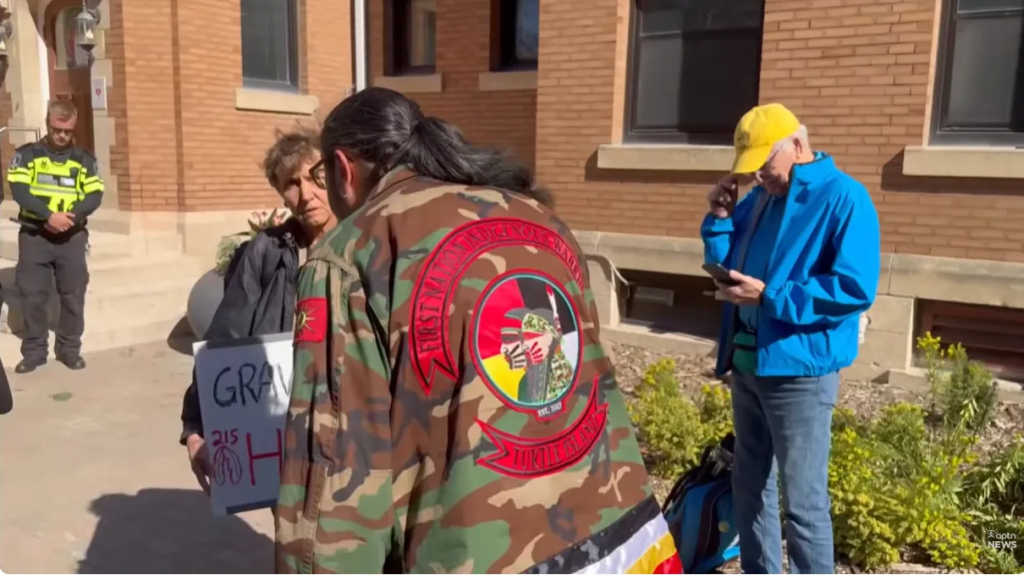
Aboriginal People’s Television Network (APTN)’s documentary “Dismantling Denialism” purports to show why people, like Frances Widdowson, who question the Kamloops Band’s claim of finding the human remains of 215 children in unmarked or mass graves in the orchard near the former Indian Residentials School are heartless kooks, whose questions have no basis in reality.
APTN’s motivation appears to defend the honor of so-called “residential school survivors” – known by the rest of us as “former students.”
Disgustingly, the Indigenous activist movement has co-opted the language of the Holocaust of Jews during Nazi Germany’s reign, where millions of Jews were targeted for extermination in labour camps and gas chambers, due to their blood quantum of Jewishness. Millions of other people who were dissidents, Roma, gays, or ‘useless eaters’ were also turned to ashes.
Most of this co-opted Holocaust narrative appears to be due to activism by University of Manitoba criminology professor Andrew Woolford and his 2014 genocide conference in Winnipeg.[1] Subsequently the Canadian Museum of Human Rights (CMHR) was badgered and harassed into adopting Indian Residential Schools as if a genocide, despite being opposed from the outset.[2]
“We don’t have the prerogative, legally, to make that judgment if it’s homicide or genocide,” said Jodi Giesbrecht, director of research and head curator at the museum, during the opening in September 2014.
Indeed, no one has ever been charged or convicted of genocide in Canada; no one has ever been charged or convicted of homicide related to Indian Residential Schools. However, to get government and philanthropic funding and to get protestors off your back, compliance may have been seen as the more productive way to go for CMHR – plus, you get money![3]
The APTN documentary description on YouTube reads:
“In Canada, the histories of residential school survivors are being challenged by a surge of denialism. Dismantling Denialism confronts those attempts to rewrite history — and explores what it will take to defend truth and reconciliation.”
The curious thing about the Truth and Reconciliation Commission (TRC) is that it only told part of the truth; the adult perspective of former staff was cut from the budgeted operations and the researchers were told their interviews would not be transcribed. Positive stories were not allowed or were shouted down in the public witnessing sessions. The message at the kiosk at the entryway of public sessions was untrue – wildly exaggerated – and completely negative. The stories told by former students were emotionally compelling, but no evidence, cross-examination or sworn statements were required.
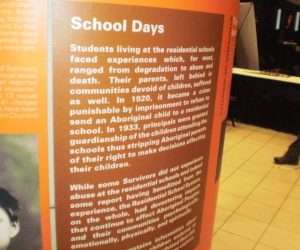
Kiosk at the entryway of TRC public hearings.
As well, Canada had just been through the Independent Assessment Process (IAP) where former students who claimed a higher level of compensations for more severe abuse, were allowed to submit a claim as a short phrase or paragraph, with a years long timeframe as to when this event occurred, they were not required to face their accuser in any court of law, which is normally a prerequisite for any trial, and the claim was adjudicated on the basis of “probability” rather than evidence.
The alleged perpetrator was denied due process of law. While the Canadian government offered each alleged perpetrator money for a lawyer, for counselling, for travel to the adjudication, for meals and related expenses, the option of having a “comfort” person attend, once at the adjudication, the alleged perpetrator was deemed to be a “witness” – not a defendant, and they were not allowed to ask questions or defend themselves.
When does the government ever fund the legal ‘defence’ of an alleged criminal? And then not allow them to defend their client anyway?
Thanks to this Kangaroo Court, some 5,315 Canadians are now “marked” as if criminals. They had been hunted down by their own government, with some 17 private investigation agencies engaged to track them all down.
But where was that list of names gleaned from, you might ask?
From the several thousand class action cases against the Canadian government and various churches, principally the Roman Catholic Church, which had operated most of the schools. At one point, the Canadian government was swamped with some 11,000 class action cases, part of what Frances Widdowson and co-author Albert Howard had named the “Aboriginal Industry” in their 2008 book.
The Indian Residential School Settlement Act (IRSSA) was a comprehensive financial settlement process (which included a Common Experience payment to any former student of $10,000 for the first year, and $3,000 every year after of attendance; as well as the Independent Assessment Process where payouts ranged from $80,000 to >$250,000). A former student could claim both.
Thus, participants in the Truth and Reconciliation Commission hearings are likely to have included recipients of these large IAP payouts, and they had learned from grifting lawyers and their own jackpot justice, that the more lurid the story, the more it plays with the adjudicator, and the higher the compensation.
Don’t take it from me. Take it from this story first published by Maclean’s in 2006.[4]
While some of the former students’ statements are undoubtedly true, and some true but exaggerated, many are beyond the pale and would never be admitted in a true court of law. In fact, lawyers and psychologists warn that “eye-witness” testimony is the least credible or reliable, especially related to child memories or Historic Sexual Assault.[5]
To be clear, I agree that in the historical record in the very early days of the Indian Residential School system (i.e. pre-1900), there are records of some brutal beatings or lashings of students that today would be criminally prosecuted. Back in the day, in society in general, children were not seen as anything more than little adults; harsh discipline was the norm and often cruel, even within ‘the best’ families or at elite boarding schools. Children were often treated as small servants and there was little leeway for misbehavior. Those were the times.
Much is made by Indigenous activists that children at Indian Residential Schools were “forcibly transferred” from their home, as if fulfilling Article II (e) of the Genocide Convention: “(e) Forcibly transferring children of the group to another group.” The Genocide Convention did not exist until 1948. This is Leah Gazan’s favorite trope, but it does not apply to Indian Residential Schools – she is misleading the public.
Due to the Rome Statute, the Genocide Convention does not apply in any case as the Convention applies only to cases after the year 2000. Indian Residential Schools had all ceased operation by 1997 in Canada, and in the latter 20-30 years of operation, the schools were typically run by the local Indigenous band and council and staffed with Indigenous people. Perhaps a priest remained on staff as administrator and for spiritual rites and a nun or two supervised the kitchen and offered personal counselling. This hardly qualifies as “forcibly transferring children of the group to another group” if the other group was made up of their own relatives, and the children had been enrolled by their parents.

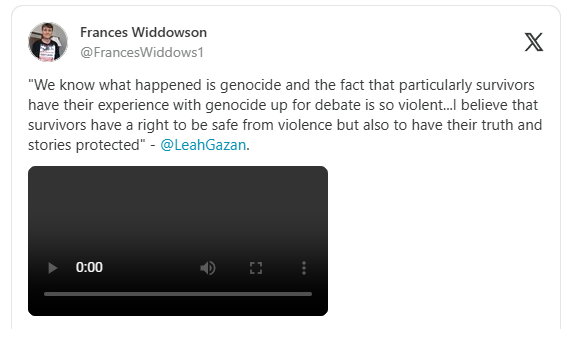
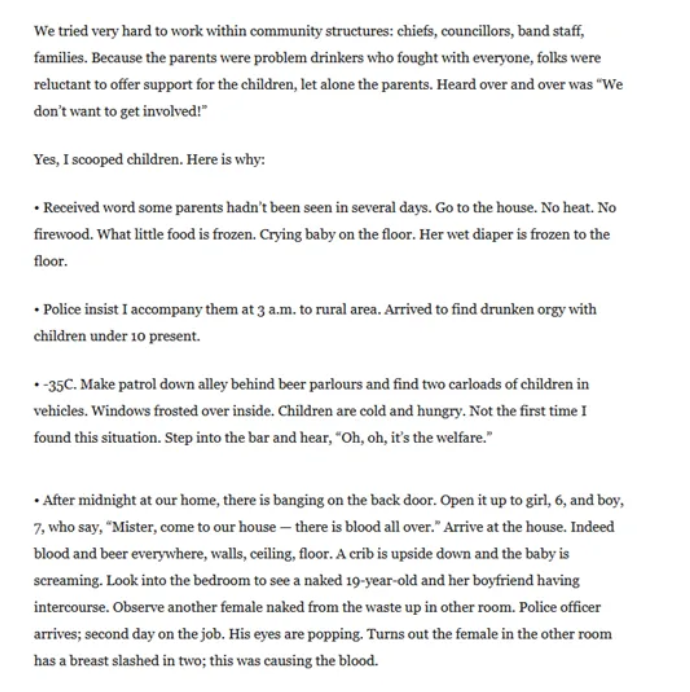
Witness the kinds of risks many children faced:[6]
A main criticism of the TRC report by historian JR Miller was that “At no time in the history of residential schooling in Canada were parents “compelled to send their children to residential schools.”’[7] Yet this “forcibly removed” or “forced to send” is one of the main messages the TRC promoted in the media.
So, as you see, I am dismantling the fundamental arguments of the APTN show. I’m showing you that APTN is distorting the historical record.
TRC Commissioners – The Epitome of Ingratitude
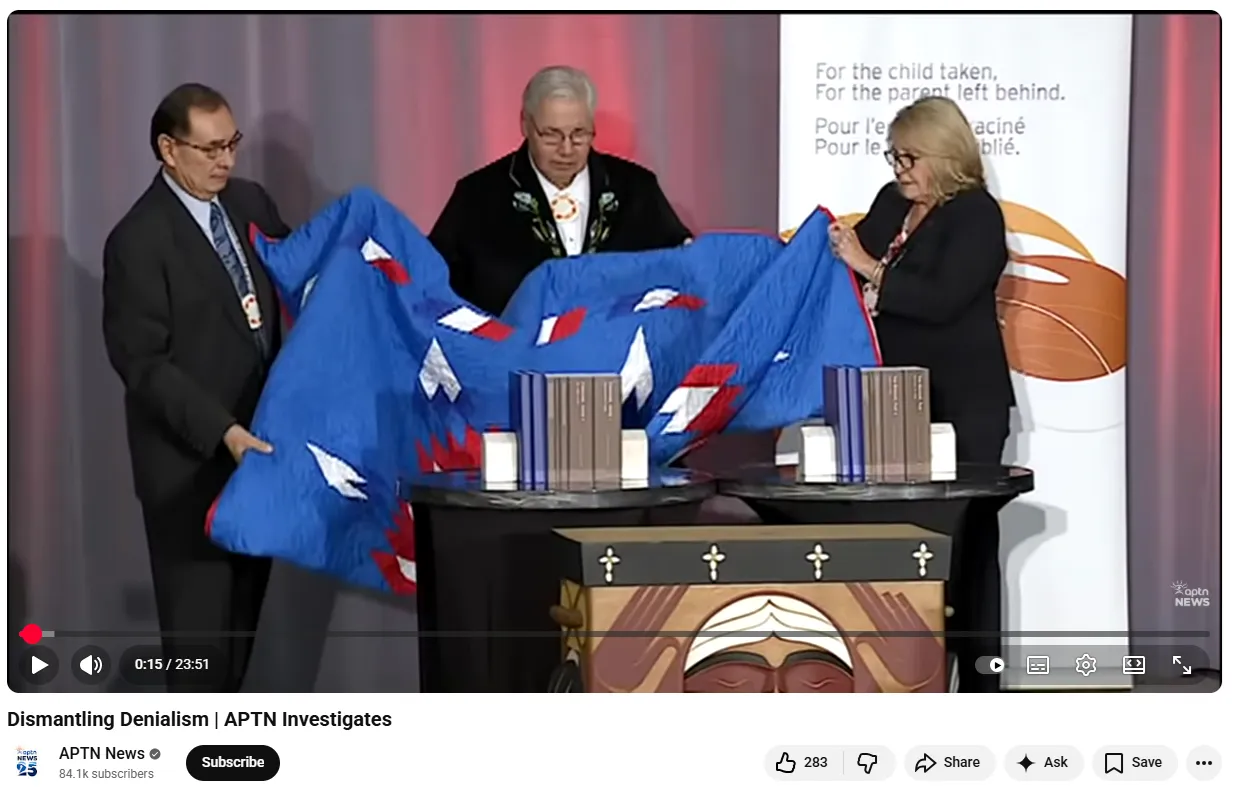
Former TRC Commissioner Murray Sinclair features prominently in APTN’s “Dismantling Denialism.”
Murray Sinclair
As I have written elsewhere: “Thus we find that the grandmother of a famous person like Murray Sinclair, former Commissioner of the Truth and Reconciliation Commission, ended up at the Fort Alexander Roman Catholic Indian Mission because her mother died. Though her father remarried, much like the story of Snow White, the new wife wanted to have her own family and not care for the children of someone else. As orphans, they were taken in by the mission. This was a common occurrence back in the day. Yet Sinclair has derided residential schools, where remarkably similar stories of orphans being rescued happened a lot.”[8]
Sinclair himself originally identified as being Métis and was elected as Vice President of the Manitoba Métis Federation in the 1970s. But over the years he shifted his self-identity to being a First Nations Anishnaabe (Ojibway).
Wilton Littlechild
Chief Wilton Littlechild was another commissioner. As I have written elsewhere, “In so many cases when the documented history is checked against the family ‘myth-tery’ there is often a surprise. Chief Wilton Littlechild was also one of the Truth and Reconciliation Commissioners, a body which portrays Indian Residential Schools as having been violent, abusive, and guilty of cultural genocide. His biography notes that Chief Littlechild entered residential school at age six, one year younger than enrollment age. He was from a large family of seven sisters and four brothers. His grandparents raised him. Littlechild’s grandfather hosted Indian Residential School picnics at his yard as the school was on reserve. It is surprising to learn that Chief Littlechild was allowed to stay at Indian Residential School until he was 20, despite the leaving age normally being 16. If it was such a bad place, why stay four more years? And if government funding ended at age 16, why was he allowed to stay longer? If it was such a terrible place, why didn’t his grandparents take him out and keep him home?”[9]
At the Truth And Reconciliation Commission Of Canada, OMI (Missionary Oblates Of Mary Immaculate) Gathering of May 2-3, 2011, in Saint Albert, Alberta, what did Commissioner Wilton Littlechild have to say?
“So on the call for gratitude, I just want to express my own personal gratitude to all of you for the, what is it? Six hundred and twelve years you’ve dedicated to us. ‘Cause I’ve said many times that for me, I probably would have been found on skid row somewhere dead years ago had it not been for, had it not been for residential school.”… “And we’ve always said at the beginning that we need a balanced story. Sometimes those who have had a good experience in residential school stay back, because they’re intimidated by the level of negative stories.”[10] -Chief Wilton Littlechild, Commissioner, Truth and Reconciliation Commission (bold added)
Littlechild’s statement seems to defy the unending claims of horrific abuse experienced at Indian Residential Schools, which many Indigenous people claim led them to a life of despair on the street. By contrast, Littlechild is stating that his Indian Residential School experience and the dedicated service of the Oblates kept him from skid row and an early death.
Marie Wilson
And what of Commissioner Marie Wilson, wife of Dene leader and author of “Stoneface,” Stephen Kakfwi?
“Marie Wilson, a commissioner of the Truth and Reconciliation Commission, said thousands of children who died in residential schools are buried across Canada, ‘many of them in unmarked graves, many of them in graveyards where their own family members perhaps never had the chance to do proper spiritual farewells or sending-home ceremonies.’” – Western Catholic Reporter, April 22, 2013
This was a speculative comment, but clearly one that has driven the Indian Residential School narrative.
In fact, the 2015 Truth and Reconciliation Commission reports state that 423 children had died AT Indian Residential Schools over the course of 113 years and 139 schools (some claim 143 schools; depends on time frame/definition)
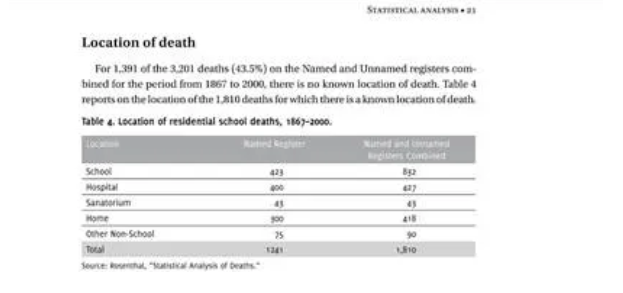
The TRC also highlights that most of the students died of TB.
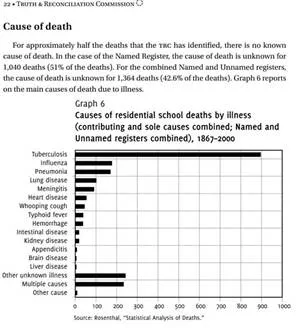
According to Stephen Kakfwi, in his book “Stoneface” he says that his mother had been taken away to residential school at age five and did not return for ten years. Shortly after returning, her family passed away in an epidemic. All of them. Since the age of admission to a school was seven, this suggests that either the family was destitute or neglectful, or infected with TB – in which case, health officials had the legal right to remove a person at risk of contracting the disease, or one who could spread it.
Sadly, years later, Kakfwi’s mother did contract TB. He explains that she was away at a TB sanatorium for six of the first twelve years of his life, though not consecutively. In 1961, he says that his mother had a lung removed to stop the TB from spreading. Typically, she was treated at the TB hospital in Aklavik. This is why he ended up at Grollier Hall.
He recounts how in 1960, he and his brother Everett flew in a Single Otter float plane back home for the summer. The float plane unloaded all the children at the dock to a grand reunion of parents, grandparents and siblings, but there was no one who came for Stephen and Everett. Both their parents were still in the TB hospitals. As is the case in many Indigenous families today, the grandparents step up to care for the children, if they are able. Kakfwi writes that his grandfather Gabriel was a devout Catholic who would say the rosary every morning. He was also a successful entrepreneur, though effectively unschooled. When Kakfwi badgered him for some pocket money before going back to residential school, Grandfather Gabriel gave him a “…beat up little pencil probably about three inches long. He said, “That’s what you’re going to need.”
Insights on Ingrates
What do we glean from these three stories of the TRC Commissioners? We see that the IRS system rescued Murray Sinclair’s grandmother when her step-mother abandoned her and her siblings. We see that shape-shifting in Indigenous culture seems acceptable, with Murray Sinclair seamlessly going from Metis to First Nations.
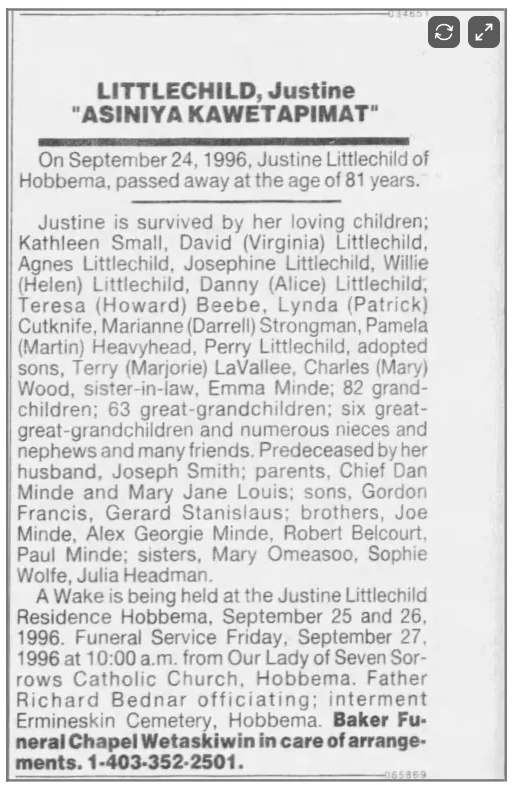
We see that Wilton Littlechild was also rescued from destitution by Indian Residential Schools. He was already being raised by his grandfather Chief Dan Minde, a strong supporter of Indian Residential Schools; likely the siblings had been farmed out as, in this story of family life at the time, written by his sister Agnes, we can see that they were living life on the edge.
Angnes Littlechild Family History
We see that Wilton Littlechild publicly thanked the Oblates for saving him from a life of despair, but that is rarely now reflected in media statements about IRS. At least he is grateful for hockey. To him, hockey saved his life.
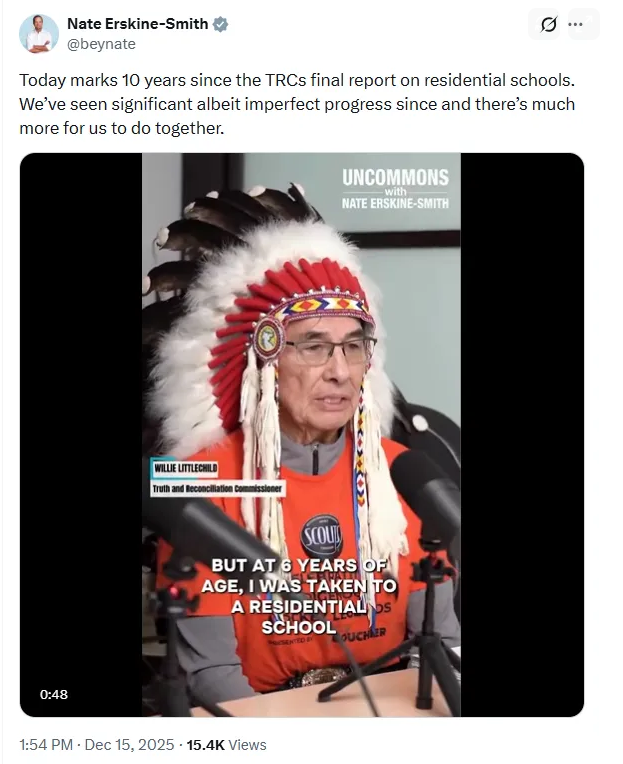
APTN claimed to be “Dismantling Denialism” and that people like Frances Widdowson are challenging the histories of residential school survivors with a surge of denialism. Yet, APTN seem to be operating from a basis of censorship or exclusion of the information I just provided to you (with many thanks to diligent researcher Nina Green).
We see from the foregoing that the Canadian government made heroic and unceasing efforts to help northern Indigenous people heal from TB; that Indian Residential Schools provided care, sustenance and education to children who were often orphaned by TB or left without parental care for long months of treatment. We also see that Catholicism had long been adopted by these families and was not imposed upon the children to ‘forcibly convert them’ as is often ascribed to IRS. The families had already adopted Catholicism in all three of these cases. Yet, the TRC Commissioners appear to be happy to be part of a mass Canadian blood libel against the very Church that made it possible for them (or their partner, in Marie Wilson’s case) to survive and thrive.
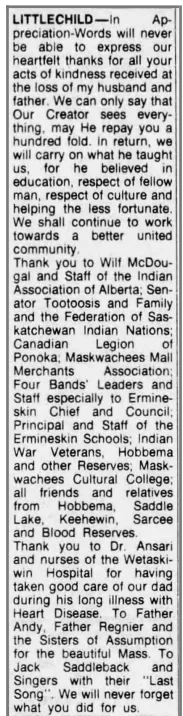
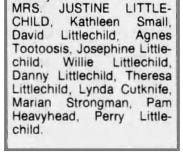
Obituary of Wilton Littlechild’s father, Joseph Smith Littlechild, posted Oct. 18, 1983.
When do we ever hear about how these schools saved so many children from abject poverty, rejection and abandonment by a new partner (as for Murray Sinclair’s grandmother), or being orphaned, either due to death or long-term TB care treatments like those Stephen Kakfwi’s mother endured?
You would think the National Centre for Truth and Reconciliation and their Chief Archivist would be eager to balance the story with these facts about the Commissioners of the TRC. But they are not.
Crickets. Ingrates.
If you pick up a starving dog and make him prosperous he will not bite you. This is the principal difference between a dog and man.
Vested Interests
Let us ponder why such information is not part of the broader narrative? Most people think that the ~6,500 recollections of former Indian Residential School students is representative of what happened, but in fact, this is only about 4% of all the students who ever attended. The TRC table (above) indicates that 423 children died AT Indian Residential Schools. This means that over 113 years of operation, 3.7 children would have died per year on average, over 139 schools, meaning the death rate was 0.03 per school per year. Even if one accepts the claim that 4100 children died at IRS, that would be 36 child deaths per year. Divided over 139 schools, that leaves a death rate of 0.2589 child deaths per school per year. That’s not genocide, not matter how sad these deaths of children are.
This crop of children also attended at a time when the IRS system was the child welfare system. Many of the children came from troubled homes. What of those children who were orphaned? No wonder many children might have been strongly imprinted with images of death, graves, ambiguous losses and desolation.
One reason the powers that be are so intent on silencing Frances Widdowson is that she was the one who early-on identified the “Aboriginal Industry” – now also known as the “Indigenous Grievance Industry” (IGI) – a sector of elite Indigenous or ‘part-endians’ (as I like to call them) and lawyers or other grifters who have created a multi-billion dollar way to drain your pocket book.
The IGI is operating in a world separate from ordinary Canadians, and indeed, separate from most parliamentarians. There was a time when IGI demands for restitution, compensation or land claims, were subject to parliamentary review and legal challenge.
This changed when then Attorney General Jody Wilson-Raybould issued a practice directive, just as she was leaving office, that the Crown should not contest claims, but rather should settle them.
This was like handing the keys to the tax pool to the very well established IGI.
The Indian Residential School Settlement Agreement was supposed to END all claims and class actions – that was the intent. Indigenous people constitute only 1.8 million people. Yet, Canadians have paid out billions of dollars in various forms of compensation. Not long ago someone told me that a “Cows and Plows” payment was incoming for a band. This concerned the Indigenous claim that insufficient agricultural equipment and training had been given to Status Indians a hundred or more years ago. The person said the payments would “not be much, maybe only $20 thousand or $40 thousand per person.”
These are staggering numbers to ordinary Canadians – for many working people that would be their entire income for a year.
Obviously, people with vested interests do not like people like Frances Widdowson or me exposing these facts, because it will end this Pity Ponzi scheme once Canadians grasp the scope and grift involved.
Sadly, thousands of ordinary Indigenous people still live in abject poverty on reserve, in over-crowded houses with no running water, while BILLIONS of tax dollars have filled the pockets of the actors in the IGI.
One of those actors is the NCTR. Canada already has the Library and Archives of Canada, but out of the IRSSA, there was an agreement to do the TRC, and from it to establish an institution to hold the files. In my view, this was completely unnecessary and now this center for “Truth” and Reconciliation is limiting public access to materials that we paid for. Furthermore, every new establishment needs a building and staff, right?
For the establishment of the NCTR and operations:
In Budget 2022, Canada announced $60 million in funding towards the overall cost of the Centre’s new facility, in addition to support for community-led efforts to locate, identify, memorialize and commemorate missing children and unmarked burials, and the full disclosure of federal documents related to residential schools.
In addition, today the Government of Canada announced funding of $28.5 million over five years for the NCTR to continue its vital work, including collecting, reviewing, and making accessible residential school records, and supporting community-led efforts to locate and identify unmarked burials. The funding will support numerous initiatives including the National Residential School Student Death Register, the online National Cemetery Register, and the National Advisory Committee on Missing Children and Unmarked Burials.[11]
——-
All this money …yet only 1/3 of all potential Status Indian Students ever went to Indian Residential Schools; most for an average of 4.5 years.
The National Centre for Truth and Reconciliation, where Frances Widdowson stationed herself for debate, even had to contrive the list of names for their memorial banner to arrive at ‘thousands’ by including people whose deaths had nothing to do with Indian Residential Schools, as well as any death of a student that was within a year of attendance, no matter the cause. This had to be pointed out in an op-ed by James McCrae, former attorney general of Manitoba and a Canadian citizenship judge.[12] How’s that for ‘truth’? Is that what we paid for?
Along with this is a myriad of other grants that are flowing out of the tax pool to ‘decolonize’ and impoverish Canada, most of this without any oversight in parliament and completely outside the awareness of the average individual. Here is a power point of some screenshots of the funds flying from your pocket to ‘reconcile’ with ingrates.
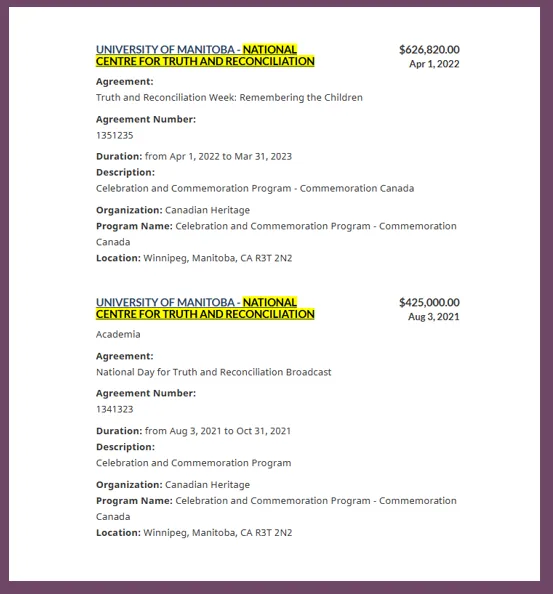
APTN did not engage in “Dismantling Denialism” but rather propping up their own vested interests in seeing mass graves, mass psychosis continue.
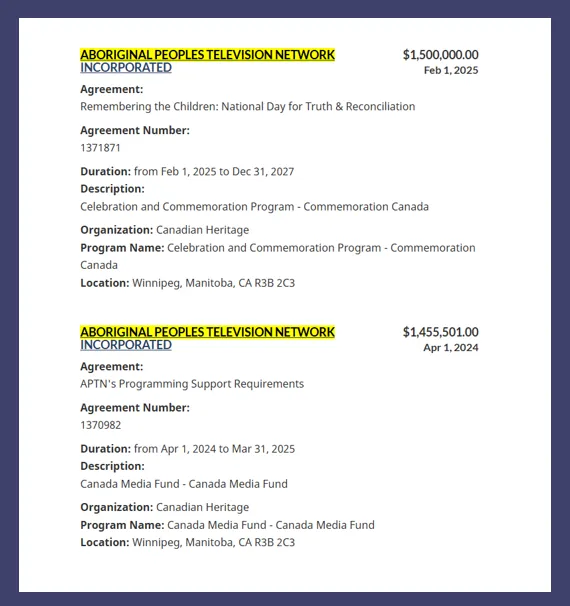
Vested Interests APTN and NCTR
For all the good will and good faith, blind belief and trust that Canadians have extended to the Indigenous community, especially the shared sense of shock, grief and outpouring of compassion – particularly from Catholics and other Christians – related to the false claim that human remains of 215 children’s bodies had been found in the orchard near the old Kamloops Indian Residential School, we are being rewarded with distorted historical information from the National Centre for “Truth” and Reconciliation, barraged with Orange Hair Shirts, guilt-trips and threats of fines and jail for revealing accurate historical information, such I have given you here.
Vested interests and ingrates are running Canada – right into the ground. It is time to be “Sorry No More.”
“Ingratitude is the frost that nips the flower even as it opens, that shrivels the generous apple on the branch, that freezes the fountain in mid-flow and numbs the hand, even in the very act of giving. It is a sin of silence, absence and omission, as winter’s sin is a lack of light; a sin against charity, which otherwise warms the heart and, in the truest sense, makes the world turn.” ~ Ann Wroe

[1] https://michellestirlingg.substack.com/p/woolfords-folly-we-are-innocent-until
[2] https://www.aptnnews.ca/national-news/national-museum-changes-stance-on-genocide-sides-with-inquiry-findings/
[3] https://friendsofcmhr.com/our-donors-page-1/
[4] https://macleans.ca/news/canada/white-mans-windfall-a-profile-of-tony-merchant/
[5] https://www.apa.org/monitor/2011/12/eyewitness
[6] https://leaderpost.com/opinion/columnists/what-really-happened-in-the-60s-scoop
[7] https://bcstudies.arts.ubc.ca/book_film_review/the-final-report-of-the-truth-and-reconciliation-commission-of-canada-volumes-1-6/
[8] https://medium.com/@UndauntedArtz2/when-family-history-turns-out-to-be-family-myth-tery-f2e3e53807ba
[9] https://medium.com/@UndauntedArtz2/when-family-history-turns-out-to-be-family-myth-tery-f2e3e53807ba
[10] https://archives.nctr.ca/uploads/r/National-Centre-for-Truth-and-Reconciliation-NCTR/b/d/b/bdb5ce8cf4e0d796702a1c4977255bba6b5dd6cd8eb5434889014710682dc051/SC012T_01.pdf
[11] https://nctr.ca/uncategorized/national-centre-for-truth-and-reconciliation-welcomes-funding-for-centres-new-permanent-home-and-long-term-work/
[12] https://troymedia.com/education/residential-school-death-list-riddled-with-errors/