This article was originally posted April 7, 2026 on the Pax Humanitas Substack. It has been republished with the author’s permission.
In yet another webinar dedicated to combatting the shibboleth of residential school denialism, Dr. Sean Carleton, Carey Newman, Paul Barnsley, and Peggy Janicki tried to convince themselves that they are on the right side of history regarding the claim of missing children in unmarked burials associated with former Indian Residential Schools (IRS).
“The reason that we are seeing all these attacks is because we are winning,” crowed Carleton while also noting that denialism is increasing across Canada. To be sure, what Carleton et al try to pejorate as denialism is simply rational and healthy critical thinking.
Nearly five years after the shocking news that the discovery of 215 children’s remains had been confirmed at the former Kamloops IRS, the public can see that there is no evidence of any such thing. Rather, what we are seeing is a restated refusal by the perpetrators of the sensational claim to do anything that might expose the claim as false, especially excavation.
The absence of evidence after the claimed confirmation has been a disquieting truth for Carleton and company. They rightly fear the undoing of the Reconciliation zeitgeist because of growing public resentment over the social havoc wreaked by the 215 claim. After over 120 churches were torched, the public expects a moral reckoning that includes a resolution to the question of whether or not there are any missing children buried in an old orchard in Kamloops.
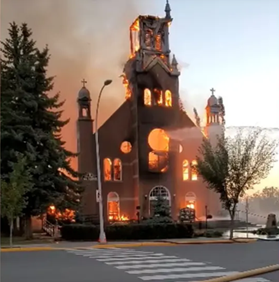
St. Jean Baptiste Parish in Morinville, Alberta, (Diane Burrel/via REUTERS).
The panelists conspicuously avoided referring specifically to the claim that 215 children’s remains were found but that claim is central to the social phenomenon they stigmatize as residential school denialism. While one of the “possible learning objectives” of the discussion was to “examine practical, experience-informed approaches used by panelists to interrupt, displace, and respond to Residential School Denialism,” the panelists professed to ignoring, dismissing and gaslighting anyone that might ask an inconvenient question.
Referring to a recent University of Victoria event where Frances Widdowson appeared, Newman, who serves as the University’s Impact Chair in Indigenous Art Practices, boasted: “The truth that we know is unassailable. Instead of engaging with them and confronting them, we organized ourselves in a circle where we protected the ‘Survivors’ flag we’ve raised on campus.”
Protected the flag from what?
Newman, best known for his artwork, The Witness Blanket, had an open microphone set up at this event and a young woman “started to ask a couple of questions that weren’t quite, um, they didn’t, she didn’t quite get to the point of denialism but she was sort of laying the ground work first, um, talking about freedom of speech and critical thought and all of those things. And we realized that this is not a person that any of us knew and so one of my colleagues and, uh, her student came over and just sort of guided the person away from the microphone.”
An unassailable truth doesn’t need muscle to defend itself but as Newman explained, Indigenous people (he claims that identity) have cultural practices of witnessing: “You listen to what people say, you think about them and then you speak: you speak back what you just heard. And this is a really important part of upholding truth.”
That, of course, isn’t what most of us understand as witnessing: the accuser doesn’t get to tell the witness what they must have seen.
Caught in a zugzwang where there is no evidence to be found of missing and murdered children at former residential schools, Carleton and his fellow travelers can only resort to gaslighting, intimidation and rhetorical chicanery. As their attempts to preserve a false narrative become increasingly absurd, so does the unintended irony.
The Gravers’ insistence on shielding the 215 claim from scrutiny has resulted in an epistemic crisis that can be seen in a quote read by Carleton: “Reconciliation is the process of accepting what happened and growing from it.”
What exactly happened, though, and how do they know that it happened? Mass murder is claimed to have happened including the tossing of babies into incinerators. Barnsley, a Producer for APTN Investigative News, argued that IRS ‘Survivors’ should be believed like we generally believe women who claim to have been sexually abused. “I believe these people without any hesitation whatsoever,” confided Barnsley.
Barnsley then quipped, “These residential schools became theme parks for pedophiles because word got out that nobody was overseeing it. The indigenous kids were not seen as worthy of protection as the white kids.” Word got out how? Barnsley is casting aspersions that he can’t substantiate and he seems to be forgetting how many aboriginal people worked in these schools.
Evidently exasperated by demands for proof, Newman moaned, “We get distracted by phrases like, ‘Where are the bodies?’ We don’t need the bodies to know about the terrible things that happened.” If you want to suggest that there are hundreds or even thousands of homicides at the schools, you do need to have some bodies or even some names for who these victims were. Just because A, B and C happened, that doesn’t mean that D also happened, and D is genocidal killing in this case.
The webinar really starts going off the rails at that point. Barnsley seems to realize that extraordinary claims require extraordinary proof but he clearly believes that somewhere in Canada there is documentary evidence, if not forensic evidence, to be found of these extraordinary claims. With no sense of the irony, Barnsley remarked: “Whenever we hear an absolutely shocking story from an Elder and we go to try and independently verify it, I think it is safe to say, the more shocking it is, the harder it is to find evidence of it. And we know the government has it.”
It doesn’t occur to Barnsley that any such documents simply may not exist because the events never happened. Shadowing the recent release of a totally blacked-out report on what Tk’emlups te Secwepemc did with the money they got for excavations they never undertook, Barnsley griped, “If (the document) does come out, it’s so heavily redacted, it’s useless.”
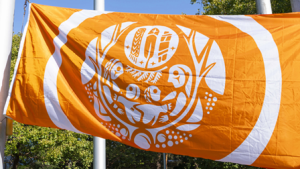
Survivor flag; University of Victoria, B.C.
In a welcome departure from the previous routine of never mentioning any denialist by name, the panelists frequently referred to Frances Widdowson, who has become a central figure in disputing the 215 claim. Barnsley scoffs at Widdowson for her use of Kevin Annett’s fictions as an example and explanation of where all these wild stories of murder and other infamies originate. Incredibly, Barnsley sees the debunking of Annett as the debunking of Widdowson.
Barnsley relates how Annett “started going around saying there was a gigantic number who died and had been disposed of in these schools.” Annett claimed there were 50,000 missing and murdered students; a third of all who ever attended IRS (the late Murray Sinclair at least had the decency to pare the tally down to a more modest 15-25,000). “Annett,” said Barnsley, “would show up at places and wave a bone around and say it was of a child that was excavated outside of a residential school.” That bone was later proven to be animal. Despite this being a nearly identical scenario to the story of a human rib bone being allegedly found at the infamous Kamloops orchard (the bone has since disappeared, evidently under Tk’emlups’ watch), the panelists avoided mentioning the parallel.
“So evidence is tricky here,” Barnsley laconically related. To work around that tricky evidence, Barnsley referred to the Delgamuukw decision which established that “oral history is as reliable as documentary history.” Barnsley states that there are Indigenous cultural traditions that strictly govern oral history but we have to take his word for it because that is not a falsifiable claim. Therefore, Barnsley concludes, the ‘absolutely shocking’ claims of Survivors should be believed, because like women relating “tales of abuse about powerful men,” at some point you just have to “believe the victim.”
The problem is that wanting to believe the victim can lead to confirmation bias and the absence of evidence can then be rationalized as a conspiracy to conceal the evidence.

From Ian Humber, Registrar under Ontario Funeral, Burial and Cremation Services Act.
“I wish I could say it’s easy to find absolutely clearcut evidence,” Barnsley confided, “but that’s not always the case. In some cases it’s because the colonial governments weren’t interested in preserving evidence of some of the things they did, you know, 100 years, 150 years, even 20 years ago.”
Barnsley related APTN’s frustrated attempts to confirm the use of an electric chair at St. Anne’s IRS to punish students. The notorious electric chair was only some prank contraption put together by staff and students but Barnsley exemplifies just how fervent some wits are in their conviction that every imaginable evil occurred at residential schools. The lurid tales of priests throwing newborn infants into school incinerators is another example where apocryphal tales of past horrors are fabricated, even from whole cloth, to serve contemporary narratives of victimhood. Absolute victimhood breeds absolute entitlement.
While blind reverence for IRS Survivors may have Barnsley believing things that he can’t prove to be true and disbelieving the possibility that Survivors could be wrong, Carleton represents another kettle of fish. Carleton does understand the Gravers’ conundrum but rather than admit that there is no evidence of any murdered students in unmarked burials, he deliberately obfuscates those alleged criminal deaths with the deaths known to have occurred at the schools. Overwhelmingly killed by infectious disease, students were lawfully buried at cemeteries, sometimes situated on schools. These graves have often since become unmarked.
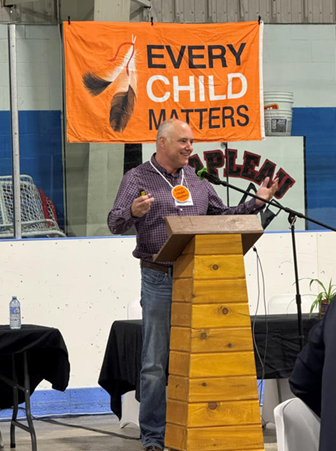
Mark Mackisocs of the Residential School Death Investigation Team; Office of the Chief Coroner Ontario.
Carleton mentioned an investigation that uncovered more deaths connected to an IRS than had been previously known. Working for the Residential School Death Investigation Team of the Ontario Office of the Chief Coroner, former OPP constable Mark Mackisoc and his team recently announced that a further 21 student deaths connected to McIntosh Residential School were added to the 44 deaths recorded by the National Centre for Truth and Reconciliation. Because these are deaths “connected” to residential schools, it should be kept in mind that these may be deaths considered to be associated with the schools in a similar fashion to the way the NCTR has included in its commemorative tally student deaths that occurred within one year of school attendance and at other locations from causes unrelated to the schools. As reported in MSN news, “investigations have expanded beyond schools into psychiatric hospitals, Indian hospitals and sanatoria, reflecting how Indigenous children and survivors were frequently moved between institutions.”
The Office of the Chief Coroner was reached for clarification but has not responded by the time of publishing.
McIntosh Residential School (Credits: NCTR; date unknown).
Mackisoc noted that: “Infectious disease was the leading cause of death, reflecting outbreaks such as influenza and tuberculosis that were common during certain periods.” After disease, drowning was the most common cause. Apparently, no deaths by foul play were reported to have been discovered in this investigation. Carleton intentionally blurs the distinction between the foul play that is implied by the alleged unmarked burials and what is known of unmarked graves. Omitting the significant distinctions of both cause and manner of burial, Carleton thereby presents these newly discovered deaths by natural cause as nefarious. Deceiving oneself is one thing, deceiving others is another and that is what makes Carleton the quisling of academia.
Returning to the task of coping with an absence of evidence, Carleton argued that “there are multiple ways of truth telling” such as oral history. Newman used the Delgamkuuw decision to justify treating Survivors’ stories as truth. But we aren’t talking about traditional usage of a piece of land, we’re talking about accusing people who are still alive of capital crimes for which there is no statute of limitation, a number of whom are actually Indigenous and former students themselves.
Asked to advise youth on how they should deal with friends and family who express denialist thoughts, Newman slipped. “One of the things that I try to do when I’m in a situation like that is, rather than having the conversation on their terms where you’re saying, ‘No,that’s not true. You’re not a liar, or what you’re saying is, uh, untrue,’ is to try to talk about, to, to ask a different question. ‘What about this’? And if that’s factually based, then that can be a way to open a conversation, um, to discuss it.”
What if it is a question that isn’t factually based like, ‘Are there missing and murdered children secretly buried in an old orchard at a former residential school?’ In that case, then, is there any need for a conversation or discussion? Newman has unintentionally admitted that believing the Survivors matters more than knowing if what they say is true.
For all the bad dreams that Widdowson gives Carleton et al, they have consistently refused to cite any statement that she has made. Disparaging the speaker is not disproving their argument. It completely escapes these advocates that it is their own fallacies that are prompting more and more of the public to doubt the lurid tales of residential school atrocities.
“A big part of why we’re dealing with this (denialism) is because we’re winning. We’ve made significant progress,” Newman rallied in his echo chamber. He’s not the first person to be reduced to living in a bunker and thinking the war was still winnable.