This article was originally published July 5, 2026 on the Sorry No More Substack. It is reposted with the author’s permission.
Food for thought for your kids, on Indian Residential School genocide claims.
Warning: Distressing information is part of this work that is meant to balance the frightening narrative that Indian Residential Schools in Canada were an act of genocide – IMO not suitable for children under the age of nine. I hope the book will be read by an adult to a child, and in a similar fashion to the dialogue within the book.
There’s been a concerted indoctrination campaign in schools to make children feel guilty over the unproven claim of the Kamloops Indian Band made on May 27, 2021, that they had found the human remains of 215 children’s bodies in the old apple orchard near the former Kamloops Indian Residential School.
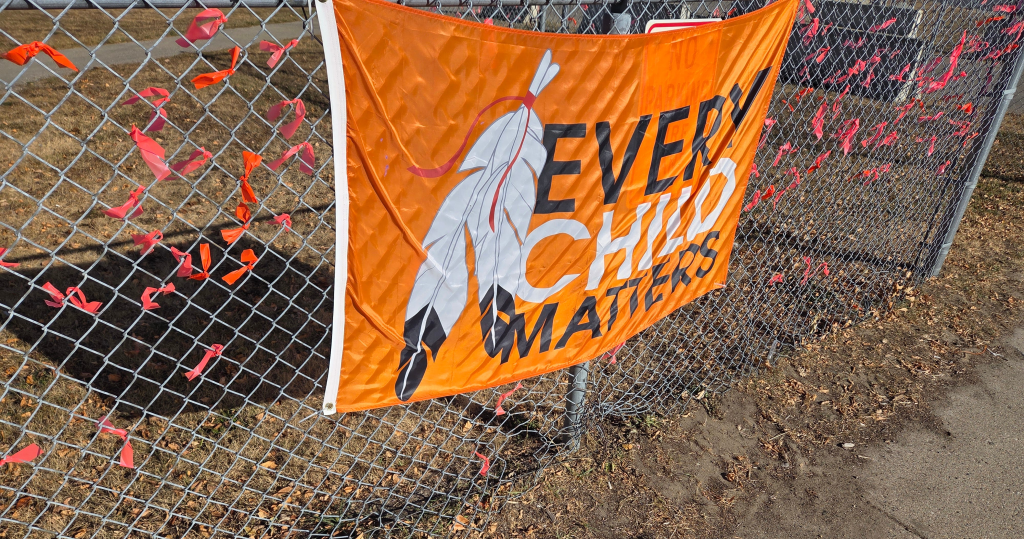
Children have been forced to tie 215 orange ribbons to school fences and to wear orange shirts to remember these allegedly dead (perhaps murdered!) children, except there is no list of names of the children claimed to be missing, and no families who have presented evidence of missing loved ones, whose cases were not resolved years ago.
Many people do not realize, that for the latter part of the operation of most Indian Residential Schools, they were staffed with Indigenous workers and administrators. There may only have been a priest on site for ceremonial rites and to lead prayers, and a nun or two for counselling, crafts, or kitchen supervision. Do you seriously believe the Indigenous staff would let dozens of their relatives – their nieces and nephews – be ‘disappeared’ by a couple of priests and nuns, and that they would not speak up??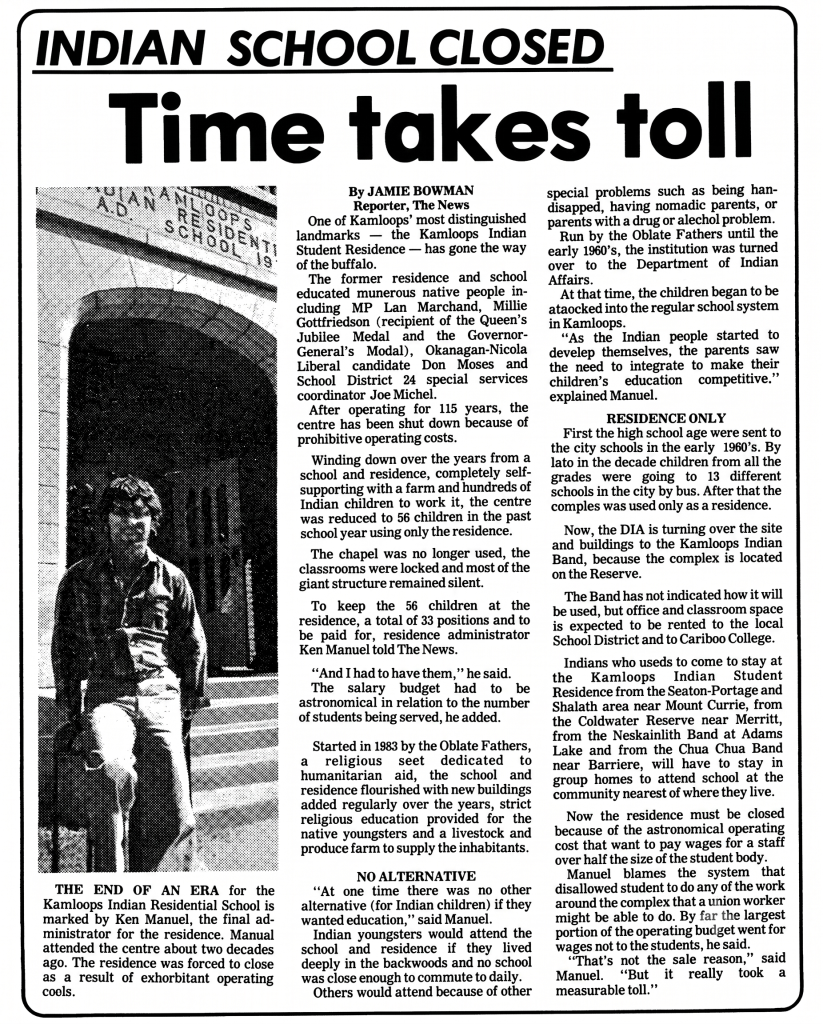
Note that Ken Manuel, KIRS administrator, was a student there two decades ago.
A fundamental principle of law and human rights is that of presumption of innocence. Canada and all the ancestors of today’s children are being accused of the most heinous crime – that of genocide – but there has never been anyone charged or convicted of this crime in Canada.
This is a no-name, phantom genocide and schools harping on it is damaging to the psyche of our children and the future of our nation.
One of the common themes that incense children is the claim that “they gave me a number” – how dehumanizing to take away a person’s name and identity! Sounds like what happened to Jews and other people the Nazi state deemed to be ‘undesirables’ or ‘useless eaters.’ They were all given numbers; tattooed on their arm.
But the Holocaust was a real genocide, proven in a court of law in the Nuremberg Trials, not just on the basis of sworn testimony of survivors or witnesses, but on documented evidence. The Nazis meticulously documented their actions.
The opposite is true of Canada’s no name, phantom genocide.
While people rely heavily on the Truth and Reconciliation Commission reports and public sharing circles, it should be noted that these were not sworn testimony, but recollections. Human memory is malleable and fallible. The adults who supervised and operated the schools on behalf of the Indian Chiefs and councils were not given an opportunity to share their documents and recollections or testimony. The TRC cut the budgets of the two women who were assigned the task of interviewing former staff. Their original $100,000 budget was cut to $10,000, out of an overall budget of $70 million. The women were told their interviews would not be transcribed.
That perspective would have added vital context. About 30% of the children at Indian Residential Schools were orphans – no wonder images of graves and death might have been imprinted on their minds. Likewise, a large number of children came from neglectful, destitute or violent homes. Some children were abandoned to the schools if the mother remarried a man who did not want the kids from a previous relationship (or vice versa). In all cases, for such a child, it would have been shocking to find oneself in an entirely new circumstance, unable to see your parents again (if dead), or only with supervision (if violent), or to long for your mom or dad, but to never understand why they did not come to get you at the end of the year, why did they not want you?
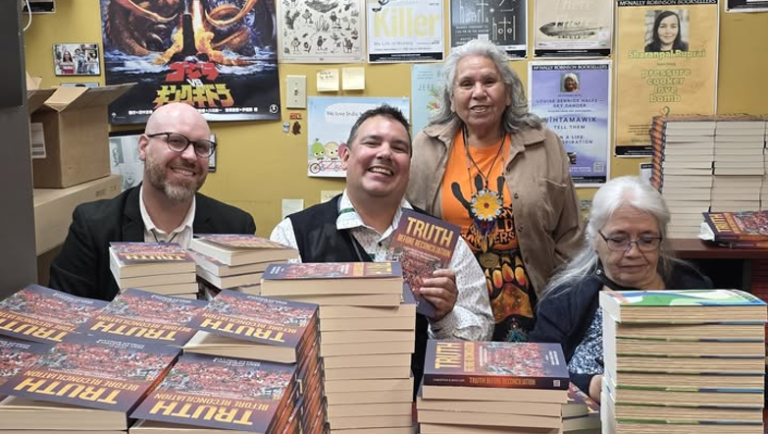
This book for youth discusses some of the common tropes about Indian Residential Schools, provides historical context, and also includes a letter from Bernice Logan of 2002. Logan was writing to Archbishop Michael Peers of the Anglican Church on behalf of the Association of Former Indian Residential School Staff, a group you have probably never heard of, who did not receive millions of dollars to tell their story to the Canadian public and who received no media coverage.
Ask yourself, why were these people, federal employees, denied a voice? Does that represent reconciliation?
What are your children really learning at school? History, or a carefully manicured narrative that just happens to exclude essential historical context.
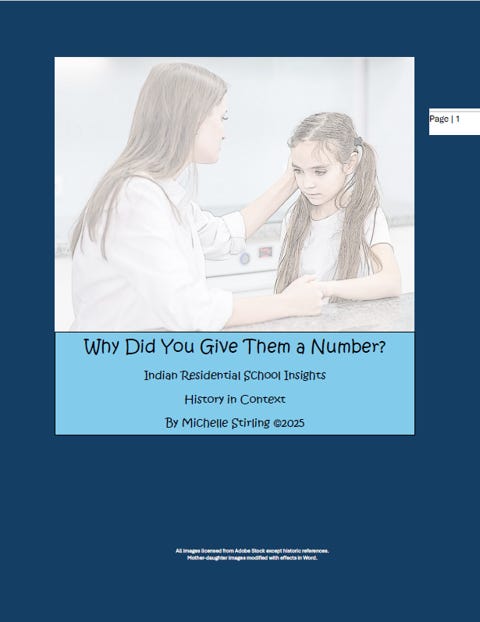
To download a pdf of the children’s book, click the link here.
Why me? Why did I write this?
I researched, wrote and coproduced a number of historical documentaries under the supervision of Dr. Hugh Dempsey, then curator of the Glenbow Museum in Calgary. I interviewed several hundred of pioneers and their descendants, local historians and academic historians of the early West. Dr. Dempsey’s wife, Pauline, was an Indian Residential School graduate, as was her father, Senator James Gladstone, the first Indigenous Senator in Canada. They were Indian Residential School thrivers.